Nvidia GeForce Mod Promises Up To 2X AI Speed On Home PCs
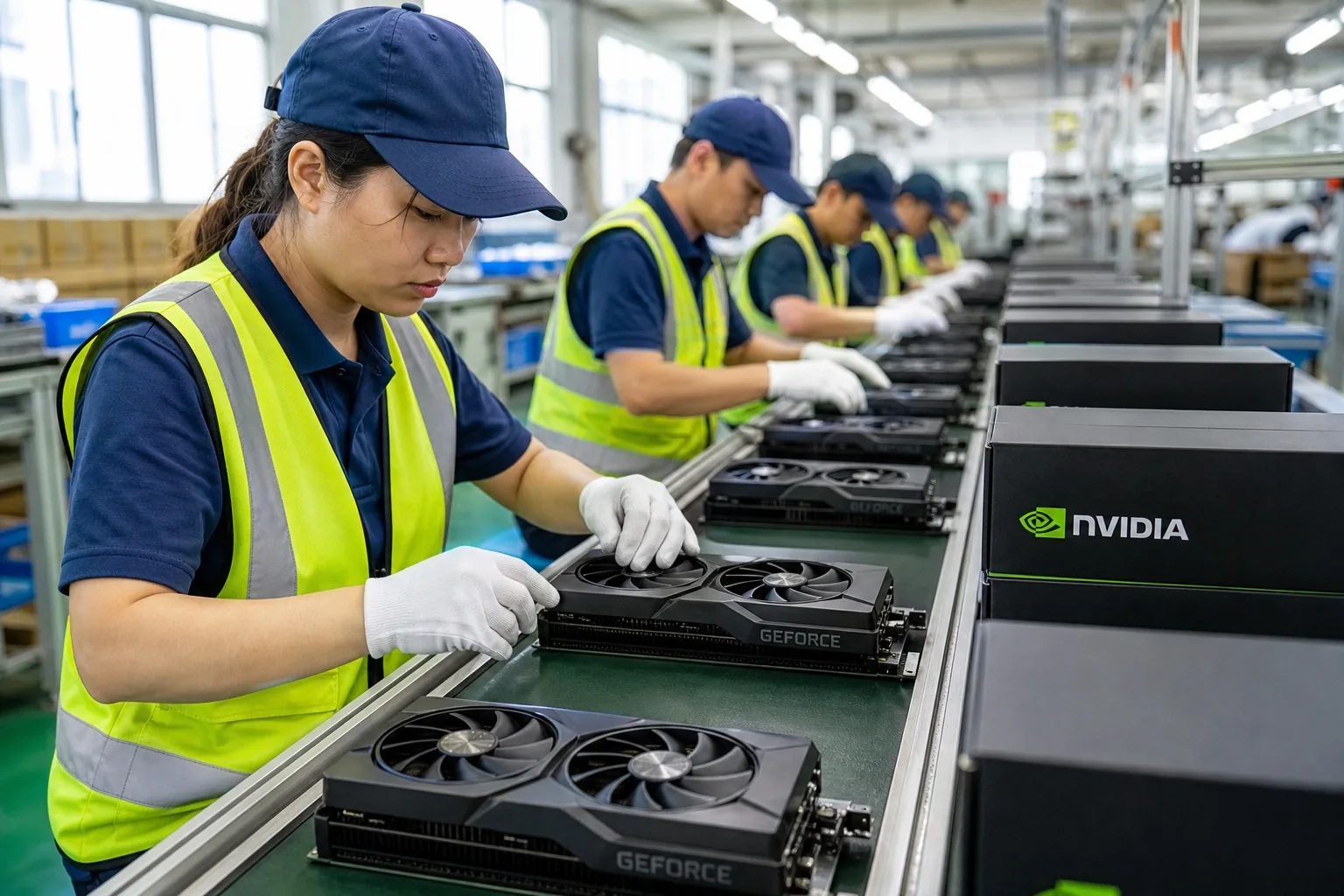
Developer Zagitta released a free GPU unlock mod that can make some Nvidia gaming graphics cards run model tasks on home PCs up to 2x faster.
Key Takeaways
- Zagitta released an open-source GPU unlock mod claiming up to 2x tensor throughput on RTX 20, 30 and 40 graphics cards
- The mod lifts FP16 and BF16 issue-rate limits on some GeForce cards affecting low-precision math used in inference, fine-tuning and image generation
- The repo says Ampere RTX 30 cards can reach as much as 1.95x BF16 throughput
- The project targets instruction issue rates for tensor core operations rather than clock or voltage changes
According to reports, Zagitta’s open-source project lifts the FP16 and BF16 issue-rate limits on some GeForce cards, which affects low-precision math formats widely used in model inference, fine-tuning and image generation.
The mod also targets hardware from NVIDIA, and the repo says Ampere RTX 30 cards can reach as much as 1.95x BF16 throughput. User-shared tests cited across coverage showed real workload gains closer to 60% to 80% on some local AI jobs rather than a clean 2x in every case.
The project targets a narrow hardware behavior, not a full card overclock. It aims to unlock instruction issue rates for tensor core operations, the matrix math blocks that accelerate modern AI models, so GeForce parts behave more like professional equivalents built on the same silicon.
That is why the headline numbers vary, synthetic tensor benchmarks can approach a doubling, while end-to-end AI tasks still depend on memory bandwidth, model size, software stack and whether the workload uses FP16 or BF16 heavily.
What The Mod Actually Changes
Modders focused the change on instruction issue rates rather than clock or voltage. The code alters how FP16 and BF16 instruction issue limits are handled, effectively unlocking tensor core throughput in situations where product segmentation had previously constrained those operations.
Because tensor cores do the dense matrix math for inference and training, lifting issue-rate limits boosts raw math capacity but does not change memory bandwidth, VRAM capacity, power draw per watt-hour or the overall system I/O that many models are bottlenecked by.
Also Read: Kazakhstan Telecom Giant Fires Up 880 Nvidia Chips To Build Local AI
Why Home Users Care About gpu unlock mod
For people running local large language models, image models or small fine-tunes on consumer cards, a 60% to 80% gain can matter more than a headline 2x claim, it GPU unlock mod can cut response times, speed batch jobs and make an older RTX 3090 or newer RTX 4090 look closer to workstation gear for certain tasks.
The tweak improves unit inference throughput in favorable workloads, but the real-world cost per unit of inference still depends on card memory size, PCIe or NVMe swap behavior, and the extra power draw under sustained load.
Those physical constraints, capacity, supply of high-memory cards, power and cooling, set practical limits on how much a software unlock can change effective performance for production use.
Modders’ Risks And Reliability
The catch is reliability. The project is unofficial, GPU unlock mod support differs by architecture and driver changes could break or blunt the patch, so anyone using these cards for paid work will have to weigh the speed gains against setup and stability risk.
The GPU unlock mod repository has already expanded beyond the original RTX 30 focus to RTX 20 and RTX 40 support, which makes this less a single-card tweak and more a live test of how much AI compute was left on the table in consumer GPUs.
Analysis, the mod demonstrably increases tensor math issue throughput, but capacity and supply remain the primary bottlenecks for many users, cards with limited VRAM will still be unable to host large models, and memory bandwidth and system I/O cap end-to-end performance. Power and cooling are nontrivial, sustained higher tensor throughput raises sustained power draw, which can force thermal throttling or add operating cost per inference.
When a company’s public positioning about product tiers conflicts with observable hardware behavior unlocked by third parties, capital spending patterns, investment in datacenter GPU fabs and HBM-equipped products, are a stronger indicator of where production-focused compute will remain concentrated. The consumer market may gain useful performance hacks, but the economics of supplying high-memory, high-bandwidth, power-optimized units for datacenter workloads still favors vendors’ heavier-capex product lines.
Users evaluating the tweak for commercial workloads should test end-to-end throughput, power and thermal behavior, and cost per inference under sustained load before deploying it into production.
Read Next: Work AI Maker Tec-Do Bets Its New Bot Can Unlock Team Budgets