AI Agents Reveal Four Core Concepts That Make Them Work
OpenAI said its Agents API is built around four main concepts on May 2024, framing agents as running systems that act across multiple steps and creating trade-offs in cost, delay, and new failure modes.
TL;DR
- AI agents are systems where a language model can decide what to do next across multiple steps, not just answer one prompt.
- The usual architecture includes a planner, memory, tools, and some form of verification or guardrails.
- They are useful for messy tasks like research, support, and operations, but simple prompts are still better for many jobs.
What AI Agents Actually Are
An agent is not just a large language model with a long prompt. It is a system that can pursue a goal across multiple turns, choose actions, use outside tools, and update its next step based on what happened before.
That shift, from answering to acting, is what OpenAI’s documentation frames by defining an agent, an environment, handoffs, and guardrails in its Agents API overview. The definition matters because it treats an agent as a running system with instructions, available tools, and a place to operate rather than as a single model call.
An AI agent is best understood as a loop that observes, reasons, acts, and then checks what happened before choosing the next step.
A normal chatbot often does one thing well. You ask a question and it answers. If it uses tools, that may still be just one pass. A true agent keeps going until it reaches a goal, hits a limit, or asks for help, which requires managing state over time and introduces trade-offs in cost and latency.
How AI Agents Differ From Single-Call LLMs
A single-call LLM is like asking a very capable assistant one question and getting one answer. The interaction is mostly static, the model gets an input, predicts tokens, and stops. That is enough for writing, summarizing, translating, and many coding tasks. By contrast, AI agents add persistence. They can keep a task alive across several steps and choose actions dynamically.
Anthropic characterizes many customer systems as agentic when they operate independently over time and mix models with tools research. If a system always calls search first, then calculator second, then writes the answer, that can be a fixed chain rather than an agent in the operational sense. An agent decides whether to search, whether to retry, which tool to call, and when to stop, which affects cost and predictability.
Single-call LLMs are cheaper and faster, fixed workflows are more reliable for repetitive jobs, and AI agents handle ambiguity better but are harder to test because they can take different paths.
A beginner mistake is to use an agent where a prompt template would work. If the task has a stable format and few branches, an agent may only add latency and extra failure modes. When the task is messy, open-ended, or depends on live data, AI agents start to make more sense.
The Four Core Parts Of Agent Architecture
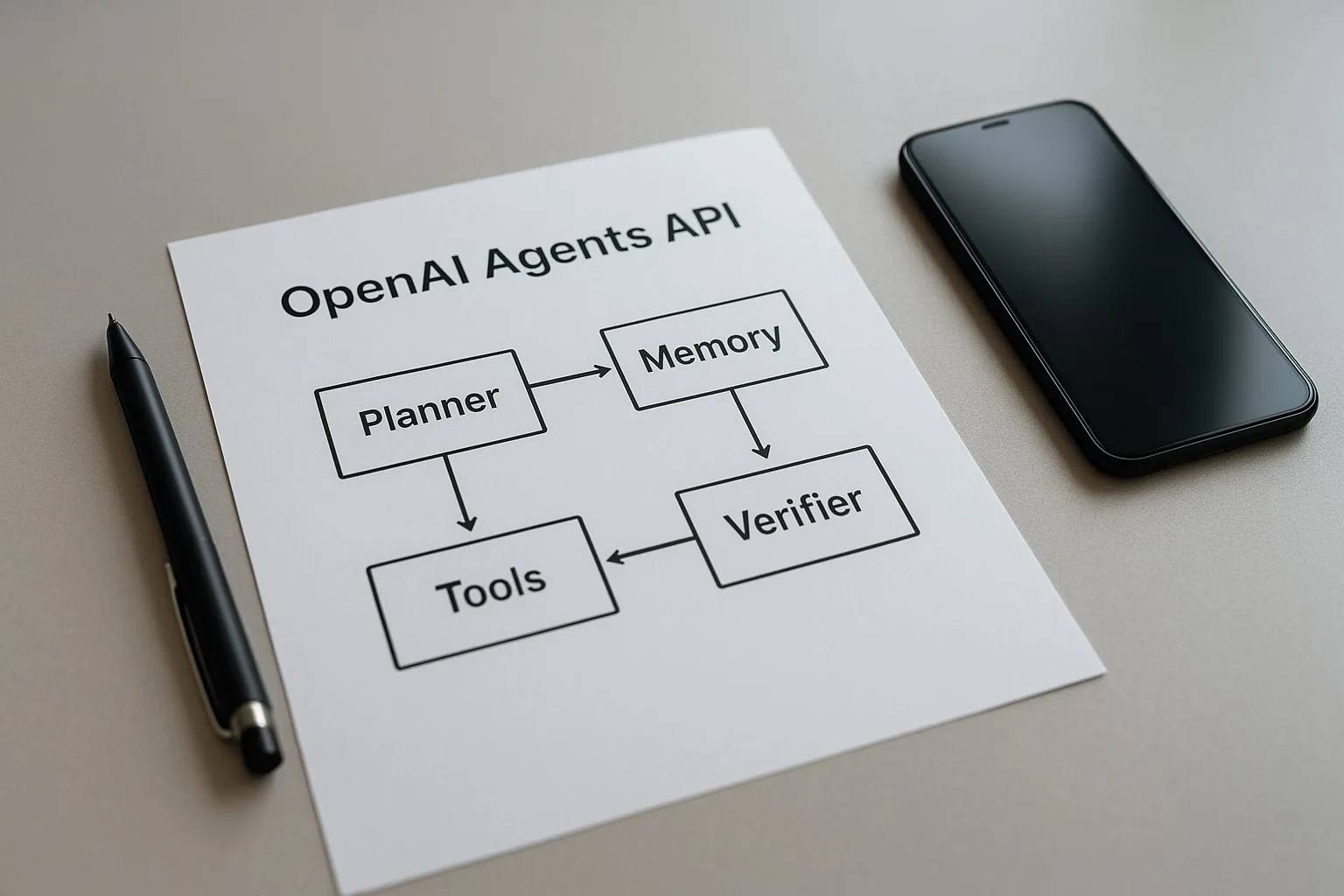
Most language-based AI agents use Four practical components, planner, memory, tools, and verification, even if the labels vary. The planner turns a goal into next actions. Sometimes the same model both plans and acts, and sometimes a separate model or prompt handles planning.
Anthropic describes a managed agents approach that virtualizes the session as an append-only log of everything that happened managed agents, which is one simple form of memory. More advanced systems store summaries or embeddings for later retrieval. Memory can be short-term for the running context or long-term for saved preferences and prior results.
Tools are any external capability the model can invoke, web search, code execution, databases, email, calendars, internal APIs, and files, and good tools are specific about inputs and outputs. Verification can be a ruleset, a second model, or both. It checks whether answers are grounded, whether tool calls succeeded, and whether results broke policy. Without verification, AI agents can drift into confident nonsense.
Planner, memory, tools, and verifier are not academic labels. They are the basic jobs an agent must cover to do useful work across steps. These pieces do not need to be separate services. A small system might use one model with a tool router and a short history buffer, while a larger system might split planning, execution, and review across several models depending on how expensive mistakes are.
How The Agent Loop Actually Runs
At runtime, an agent usually follows a repeated loop. It starts with a goal, inspects the current state, chooses the next action, runs that action, reads the result, and decides whether to continue. OpenAI suggests multi-agent systems can be modeled as graphs, with agents and tools passing work between nodes guide. Each node does a job and the output of one step becomes the input to the next.
Also Read: Anthropic Pits Claude Against Scorpion Venom Before Weeks Of Lab Work
A stripped-down loop often looks like this. It receives a goal, gathers context, picks an action, calls a tool or produces text, evaluates the result, and repeats or stops. That pattern explains why AI agents feel more autonomous than chatbots. They can branch, recover from partial failure, and do bookkeeping between steps, but branching also creates risk because a bad early assumption can contaminate the rest of the chain.
Why Memory And Tools Matter More Than Raw Model Size
Better agents often come from cleaner context and sharper tools, not just a more capable frontier model. People often assume better AI agents mostly come from bigger models, but a strong model with bad tools can still fail basic jobs while a smaller model with clean tool access can outperform expectations on narrow tasks.
Anthropic recommends giving evaluation agents a single task prompt and well-designed tools, which highlights that many agent errors are interface errors, where unclear tool names, vague parameters, or noisy output force the model to guess and waste steps engineering.
Memory creates a similar trade-off. If there is too little memory, the agent repeats work or forgets facts. If there is too much memory, it gets distracted by stale context. Good systems summarize, rank, and retrieve rather than dumping everything back into the prompt each time.
Types of memory include working memory for the current task, episodic memory for past sessions, semantic memory for facts, and procedural memory for repeated routines. If an agent seems flaky, the problem may be poor retrieval, tool ambiguity, or a session that has grown too long, architectural fixes often matter more than model upgrades.
Where AI Agents Fail In The Real World
AI agents fail in more ways than normal chatbots because they have more chances to make a bad choice. They can select the wrong tool, misunderstand a tool response, lose track of the original goal, or keep going after they should stop. Anthropic defines an agent as a model that directs its own processes and tool use while deciding how to pursue a task trustworthy agents.
That self-direction is precisely where reliability questions start. Research into measuring agent autonomy notes there is still no agreed definition of what an agent is, which makes evaluation harder and complicates comparisons across systems measuring agent autonomy. Benchmarks should be treated as probes of specific behaviors, what exactly is being measured, rather than definitive measures of overall capability.
Common failure modes include goal drift where the system optimizes the wrong subtask, tool misuse where the right action is available but not chosen, context overflow where old details crowd out the important ones, hallucinated success where the agent reports completion when it is not done, and endless loops where it keeps retrying without progress.
Security concerns rise as capabilities expand. If an agent can read email, browse the web, and call internal tools, prompt injection becomes a bigger worry. Production systems mitigate this by isolating tools, restricting permissions, and logging everything. For beginners, the safest mindset is to treat AI agents as supervised operators, not independent employees, they reduce tedious work but still need boundaries and review.
Who Actually Needs AI Agents
Not every user needs AI agents, and not every business process should become agentic. The right use case usually spans several steps, depends on changing information, and benefits from judgment about what to do next.
OpenAI research on workplace use found agent turns occurring each day across multiple parallel agents how agents are transforming work, which points to a practical pattern. Agents are most useful when work already looks like a queue of small decisions rather than one neat prompt.
Good uses include research assistants, customer support triage, coding helpers, internal operations, sales prep, scheduling, and document processing. Poor uses include one-off copywriting, basic summaries, fixed report generation, and anything with a stable template.
If a team already switches between tabs, tools, and checklists all day, AI agents can help. In high-risk fields like finance, legal, or health, keep a human in the approval loop. The smartest first question is not “Can an agent do this?” but “Does this task actually need ongoing decisions?”
Conclusion
Watch for comparisons that treat benchmark scores as definitive measures of “agent” capability. Differences in definition and tooling can change outcomes more than headline numbers. Next, monitor how providers define evaluation tasks, tool interfaces, and memory designs, those choices will determine whether AI agents improve real workflows or just add cost and risk.
Read Next: OpenAI And AI Startup Slash Drug Leads From Hundreds To A Dozen