Agent Memory Overtakes Full Context With 16 Tokens In Real FactKG Test
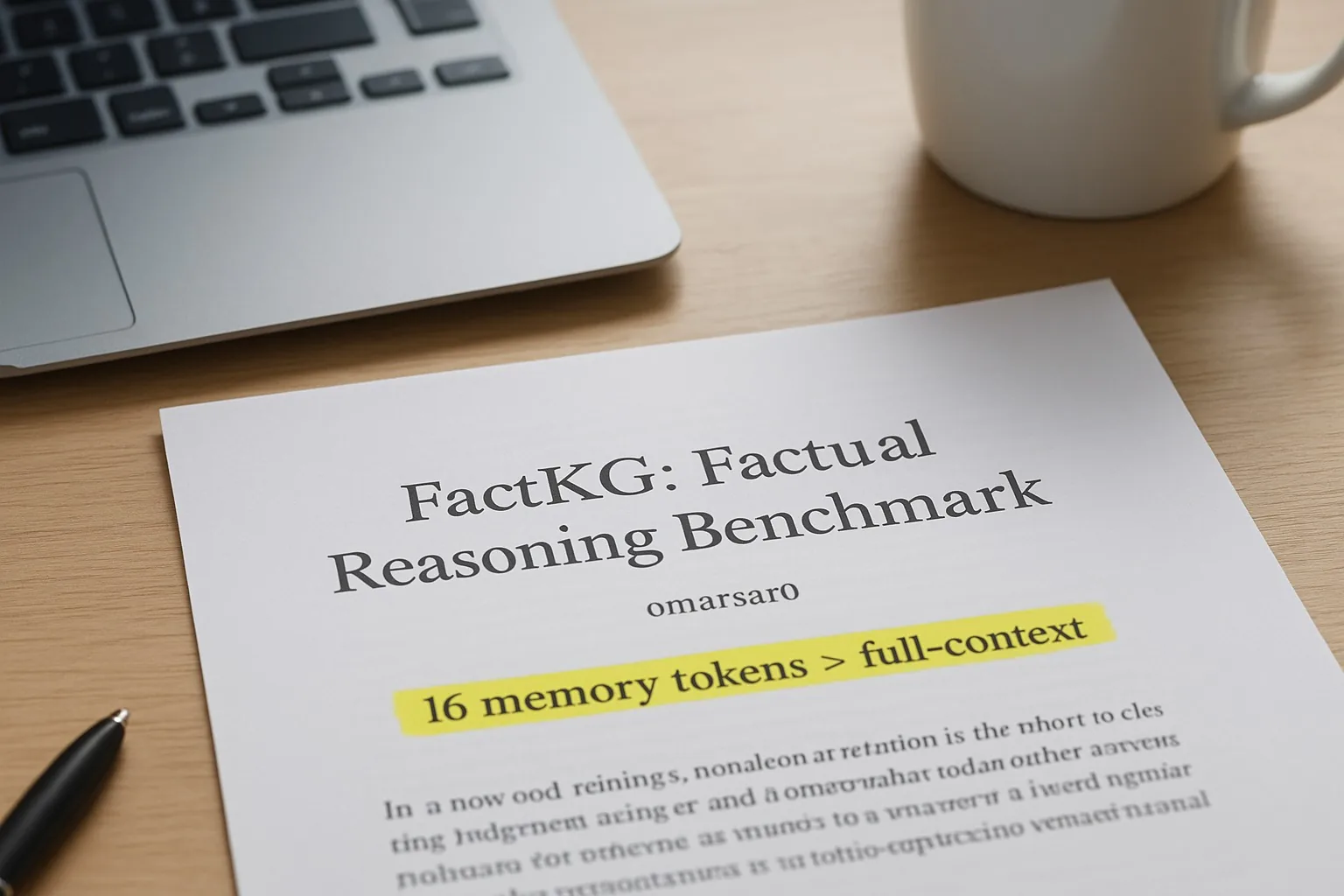
Agent memory got a fresh benchmark result on Sunday after a new paper says 16 memory tokens beat full-context inference on FactKG, a factual reasoning benchmark used to test retrieval-heavy systems.
Key Takeaways
- The paper shared by omarsar0 reported 16 memory tokens beat full-context inference on FactKG
- The paper centers on latent semantic memory for large language models
- Agent systems often include past transcripts, tool outputs and retrieved documents in every new prompt, raising cost and slowing inference
- A tiny learned state like 16 tokens reduces per-inference token count and can lower prompt-processing FLOPs and bandwidth to the accelerator
The paper centers on latent semantic memory for large language models, and the claim matters because persistent state has become one of the main bottlenecks for AI products that need to carry facts across long sessions.
Agent Memory Tries To Replace Endless Prompt Stuffing
Most agent systems keep dragging old transcripts, tool outputs and retrieved documents back into each new prompt.
That raises cost and slows inference because the model must process the same text over and over.
That is why this line of research is getting attention from builders. If useful facts can be compressed into a small learned state, models may answer with less context and lower token spend.
The claim in the post is narrow but useful.
Sixteen memory tokens beat full-context inference on FactKG. If the result transfers, some developers may not need brute-force recall by sending back an entire session history.
From Bigger Windows To Smaller Learned State
The last year in AI product design has favored larger context windows.
Labs sold bigger windows as a recall fix, and for some tasks that worked.
This technique attacks the same problem from the other side. Instead of feeding the model every prior detail, the system learns a compact representation of what matters.
That makes the approach less like storage and more like trained compression.
The model is not rereading a transcript. It uses a learned object that stands in for prior information.
The Research Arrives After Recall Became A Product Problem
The timing fits a broader shift in agents.
Teams are moving from single-turn assistants to systems that act across sessions, revisit tasks and track preferences over time.
Also Read: GPT-6 Astra Slumps 21.6 Points Behind Humans On New 3D Verification Test
That makes memory design part of product architecture, not just research. Coding agents, enterprise copilots and support bots all run into the same problem once they need continuity.
A larger context window can help, but it also increases compute cost and raises the chance that irrelevant text crowds out the useful bits.
This approach aims to cut that waste.
How It Compresses The Past
In these systems, the model does not reread every earlier sentence. Training teaches the network to write part of the past into a fixed set of learned tokens.
Those tokens sit in the next prompt like a dense summary the model has learned to interpret. In the result shared Sunday, 16 memory tokens beat full-context inference on FactKG, which suggests raw length was not the same as usable recall.
That matters to product teams at companies such as OpenAI and Anthropic that build persistent assistants.
A support agent may need account facts, prior tool outputs and verified user preferences across many turns. Full-context prompting keeps all of that visible, but it also makes every step more expensive.
Memory tokens trade transcript length for compression.
The next test is transfer. If the same approach works on coding, browsing and enterprise workflows, the technique may move from paper result to default system design.
The physical constraints determine whether this trick scales. A tiny learned state like 16 tokens dramatically reduces the per-inference token count, which directly cuts bandwidth to the accelerator and reduces prompt-processing FLOPs.
That helps latency and can lower the cost per unit of inference, provided the compression actually preserves signal.
But capacity and supply matter. A handful of tokens can only encode so much, and if you need high-fidelity recall across long, varied sessions the compressed state may saturate quickly and force more frequent writes or auxiliary retrieval.
That increases engineering complexity and could shift compute from the model forward pass to background maintenance and indexing.
Power and throughput also favor compression. Fewer tokens per query reduce memory traffic and softmax cost on large transformers, improving energy efficiency per decision.
Still, if teams trade prompt tokens for heavier train-time or controller compute, the net savings may be smaller than the headline suggests.
Finally, when product roadmaps and capital spending diverge, bet on the hardware. If a company is pouring budget into larger context windows and expensive accelerators, the business will first scale by capacity they can buy.
A compact learned state looks appealing on paper, but the industry will adopt it faster when it demonstrably lowers cost per inference across real workloads rather than just in a benchmark.
Read Next: Tencent’s Coding Agents Nearly Double Task Completion To 72.7% Without Humans