Nvidia Says 8,000 Institutions Now Use Its 6G Research Tools
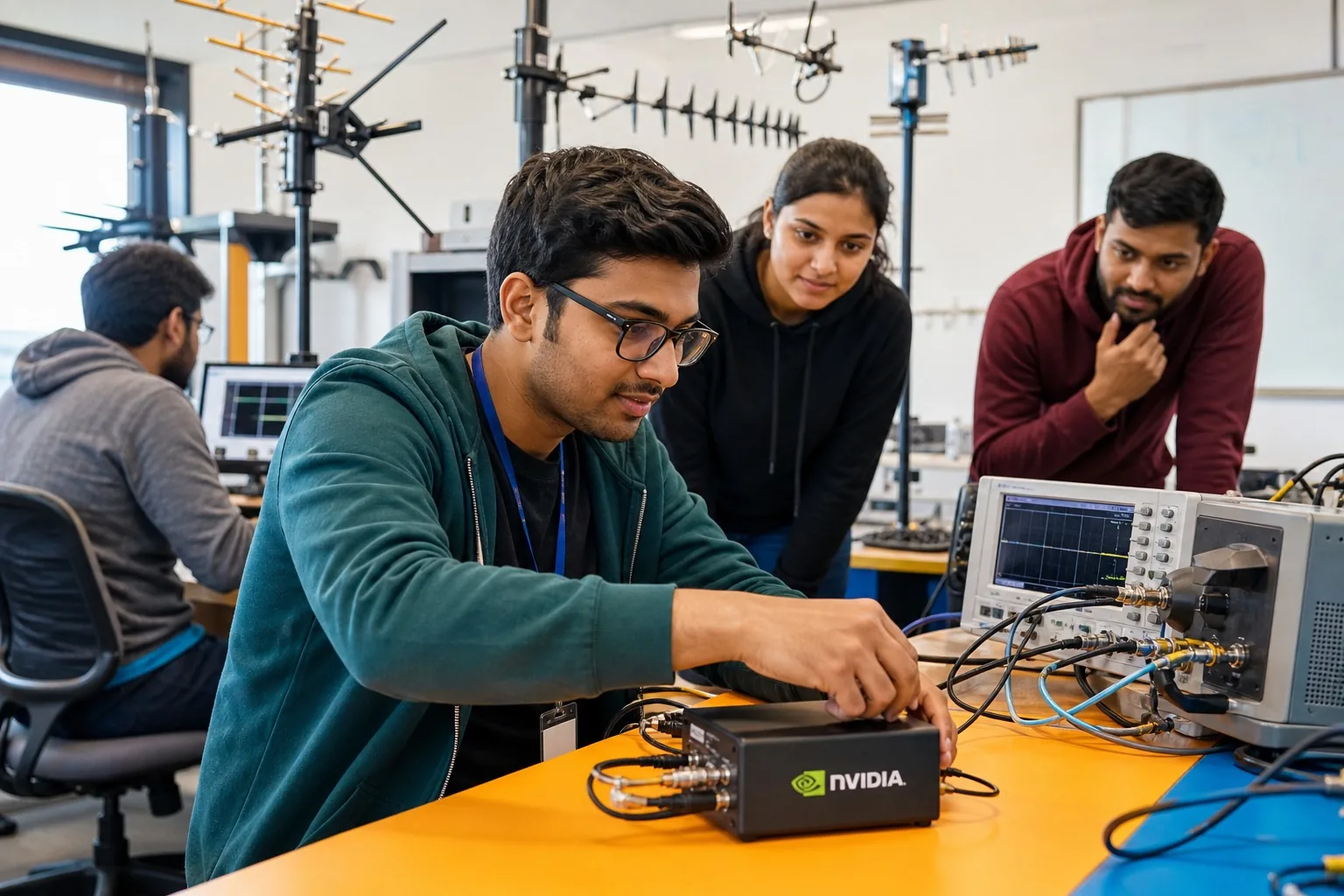
Nvidia said researchers and developers are using its open source Aerial and Sionna software to test 6G wireless ideas faster before committing to equipment and field trials.
Key Takeaways
- Nvidia said researchers are using Open Tools, including Aerial And Sionna, to test next-generation 6G network ideas more quickly
- Nvidia said its wireless stack has expanded over the past year into a broader open tool set for telecom experiments
- Nvidia said Aerial and Sionna are part of its open source 5G and 6G research tools.
- Open source tools let teams model wireless signal behavior before building hardware.
Nvidia said its wireless stack has expanded over the past year into a broader open tool set for telecom experiments. The company builds the GPUs and software platforms that power much of the current AI training and inference market and has increasingly pushed those tools into networking and robotics as well.
6G Research Leaves Closed Lab Setups With Open Tools
The news is less about a new product than a method shift. Telecom research has long relied on specialized lab setups, bespoke simulation code and results that can be hard to reproduce across institutions, and Nvidia is trying to standardize more of that work on open software.
That matters because 6G development is still early, no one is rolling out a commercial 6G network now, and researchers are testing ideas for radio access, channel modeling and system design years before carriers will commit to hardware and spectrum choices.
Open Tools change who can participate. A university team with limited hardware can reproduce parts of another lab’s experiment if both use the same software building blocks, lowering the coordination cost that often slows telecom research without removing the need for expensive compute.
Faster simulations let researchers compare more designs and refine ideas sooner.
Also Read: Invesco Hands Advisers 2 Claude Tools To Build Portfolios Faster
From AI GPUs To Future Radio Stacks
This is also part of Nvidia’s larger move to turn GPUs into infrastructure for physical systems, not only language models. Wireless research needs simulation, optimization and signal processing, all areas where parallel compute helps.
The telecom angle matters for AI readers because future networks may carry more machine-to-machine traffic from autonomous systems, industrial sensors and AI agents operating at the edge. If those systems need faster response times and denser coordination, radio design becomes an AI infrastructure question, not just a carrier engineering problem.
Nvidia has pushed that thesis before with digital twins and network simulation. Nvidia said the tools give researchers a foundation for testing ideas, comparing results and building on each other’s work.
How 6G Research Uses Aerial And Sionna
In practice, 6G research tools like Aerial And Sionna let teams model how a wireless signal would behave before they build hardware. Nvidia said Aerial and Sionna are part of its open source 5G and 6G research tools. Researchers can change channel conditions, antenna layouts and protocol assumptions in software, then measure how those choices alter performance.
Researchers can compare more designs and refine ideas sooner using these tools.
The next step to watch is whether Nvidia’s open stack becomes a de facto benchmark layer for academic 6G work, if it does, Nvidia will shape not only the chips used in AI systems but also some of the software assumptions behind the networks those systems depend on.
Open Tools lower coordination costs but do not erase physical constraints. GPU capacity and availability, rack power and cooling, and the cost per unit of inference and simulation time will cap how many large-scale experiments any lab can run.
Large GPU farms accelerate iteration, but they also consume significant power and require capital outlays. Where a vendor’s public strategy touts software openness, its capital spending on silicon and datacenter gear reveals how committed it is to turning that software into practical infrastructure.
That spending is the more reliable indicator of intent. Public messaging on openness matters, but capacity, supply and per-unit cost determine how many real-world experiments can be executed and how quickly research can move from simulation to field trials.
Read Next: Supermicro Hands Companies A Memory Saver For Thousands Of ChatsNvidia said adoption of Aerial and Sionna grew 10x over the past year, its open source 5G and 6G tools passed 1 million downloads, and more than 8,000 research and academic institutions worldwide now use them.