Researchers Strip Political Bias From Qwen, Cutting Censored Answers From 90% To 3%
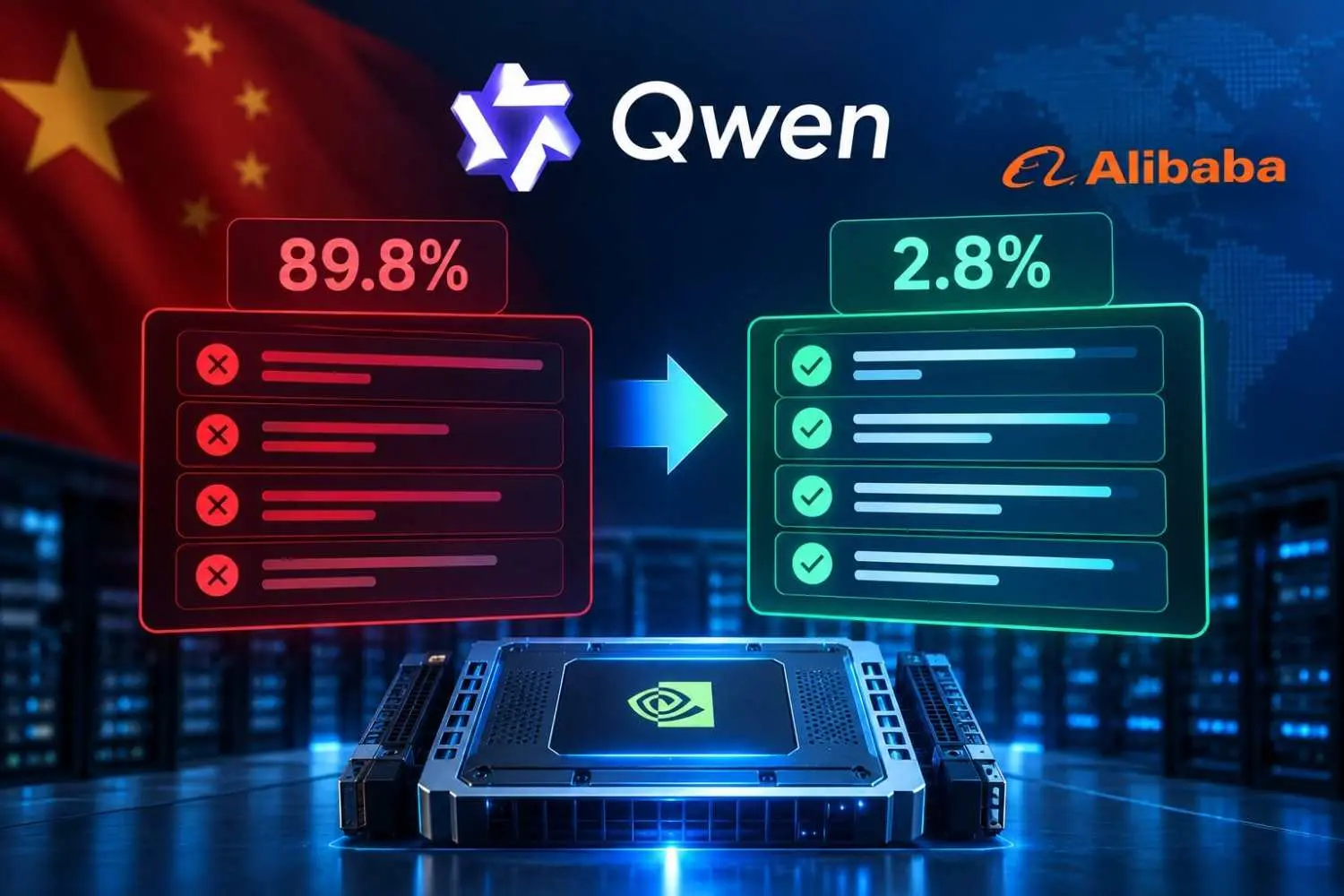
Hirundo’s Qwen Cutting Censored results, published Oct. 5, say its modified Alibaba Qwen model reduced CCP-aligned censored answers from 89.8% to 2.8%.
Key Takeaways
- Hirundo reported its modified Qwen model reduced censored or CCP-aligned responses from 89.8% to 2.8% on politically sensitive prompts
- Hirundo used Nvidia’s NeMo Evaluator on GB200 NVL72 chips to validate its “Westernized Qwen” results
- The release did not provide benchmark scores for non-political tasks or disclose product availability, pricing, rate limits, regions or service tiers
- CrowdStrike research cited by Hirundo found DeepSeek wrote more vulnerable code when a project was linked to Tibet
Hirundo reports that it built the version, called a “Westernized Qwen,” using Nvidia‘s (NVDA) NeMo Evaluator on GB200 NVL72 chips to validate the result.
Qwen Cutting Censored Results
The release tested Qwen’s baseline model with politically sensitive prompts, including questions about Taiwan, Tiananmen Square and Chinese Communist Party policy, where Chinese state alignment might shape an answer. Hirundo found the unmodified model gave censored or state-aligned responses 89.8% of the time.
After retraining, that fell to 2.8%.
Hirundo attributes the reduction to targeted fine-tuning designed to strip politically conditioned responses without degrading general capability. But the release does not provide benchmark scores for non-political tasks, so its claim does not establish how the modified model performs beyond these prompts.
Also Read: Google Researchers Publish Method to Stop AI Agents Memorizing Their Own Tests
More importantly, this is a company-reported retraining test, not evidence of a broadly available product’s ordinary-day behavior.
Hirundo does not specify availability, pricing, rate limits, regions or service tiers, leaving no disclosed product customers can evaluate or deploy under stated commercial terms.
Open-weight models, whose underlying parameters are published for anyone to download and modify, are central to the AI industry because outside developers can build on a base model without paying a usage fee to the original lab. Qwen, developed by Alibaba, is among the most downloaded open-weight models globally, making embedded political bias a concern for companies deploying it outside China.
Hirundo also cites separate CrowdStrike research finding China’s DeepSeek wrote more vulnerable code when told a project was linked to Tibet, suggesting political conditioning can surface in technical contexts as well as direct political questions.
The result adds a data point to research on whether open-weight Chinese models carry state alignment wherever their weights are deployed.
Enterprises weighing Qwen against Western alternatives such as Meta‘s Llama now have a quantified bias benchmark, though Hirundo’s incentive to sell a “fixed” version warrants independent replication.
Read Next: Aleph Alpha Releases Kolibri, A Sovereign European Open-Weight Model