Salience Labs Bags $125M From Intel And AMD To Fix AI’s Power-Hungry Wiring Gap
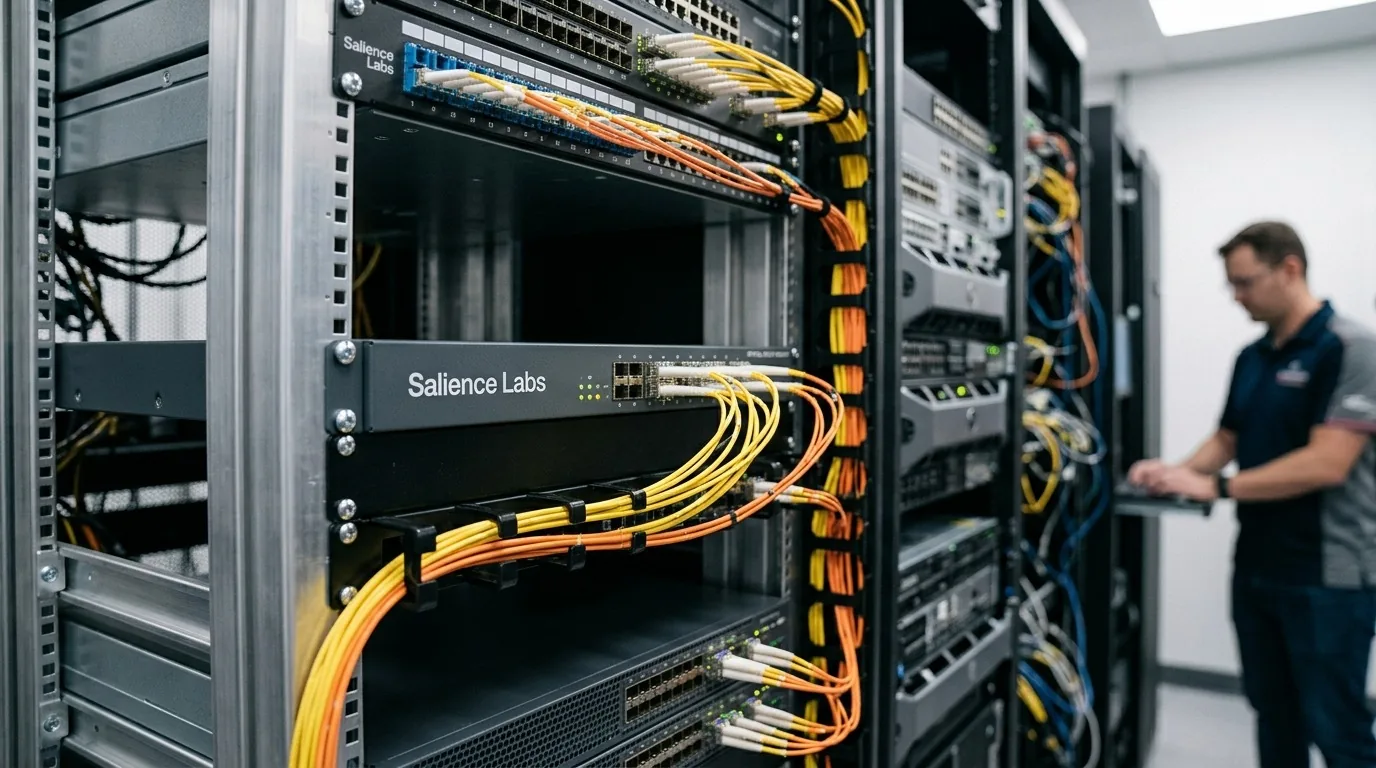
Salience Labs secured $125 million in Series B funding Wednesday to scale production of optical networking hardware built for AI datacenter infrastructure.
Key Takeaways
- Salience Labs secured $125 million in Series B funding to scale production of optical networking hardware for AI datacenter infrastructure
- Bullhound Capital led the round, with Intel Capital and AMD Ventures joining as strategic backers
- Salience Labs builds circuit switches that redirect optical signals between servers without converting them back to electricity at each hop
- Salience Labs did not specify a production timeline, name customers, provide a valuation, or disclose individual investment sizes
The round was led by Bullhound Capital, with Intel Capital and AMD Ventures joining as strategic backers, the company said. Photonic chips move data using light rather than electrical signals, cutting the energy lost as heat when information travels between processors.
Salience Labs builds circuit switches, networking hardware that redirects optical signals directly between servers without converting them back to electricity at each hop.
The company says this targets the specific bottleneck now limiting AI datacenter scale, the copper and fiber links connecting thousands of GPUs, which consume a growing share of total power budgets as cluster sizes climb into the hundreds of thousands of chips.
For operators, the physical constraint is capacity, if networking hardware supply or link power limits the number of GPUs that can be joined, the cost per unit of inference rises.
Intel and AMD, through their venture arms Intel Capital and AMD Ventures, both backed the round. Both chipmakers have reason to want faster, cheaper interconnects, since the ceiling on how many accelerators can be networked together directly affects how large a single AI training job can run.
Neither company disclosed the size of its individual investment, and Salience Labs did not provide a valuation alongside the raise.
Why Photonic Chips Became The Datacenter Chokepoint
AI training clusters have grown from thousands to hundreds of thousands of GPUs over the past three years, and the electrical copper links that connect them were not designed for that scale. Copper interconnects lose signal strength over distance, forcing racks to sit close together and limiting how datacenters can be laid out.
Photonic links carry more data over longer distances with less power loss, which is why optical networking has become one of the most contested layers in AI infrastructure investment alongside the chips themselves.
Nvidia, Broadcom and startups including Ayar Labs have all pursued versions of this bet.
Salience Labs’ pitch is a circuit-switch architecture that reconfigures connections on demand, rather than fixed point-to-point optical links, letting operators repurpose the same optical fabric across different workloads without rewiring hardware.
From Lab Research To Production Hardware
Photonic computing research has circulated in academic and defense circles for more than a decade, but commercial traction only accelerated once AI training costs made power efficiency a line-item concern for cloud operators.
The round landed the same week chipmakers gathered at the Open Compute Project‘s annual summit to detail new rack-scale AI designs, a sign that power and interconnect constraints are now being tackled alongside raw chip output rather than after it. For compute buyers, lower link power matters only if it reduces the cost per unit of inference after the added optical hardware is paid for.
Also Read: Hot CPI Report Sinks Nvidia As Rate-Cut Bets Fade, S&P 500 Drops 1%
What Comes Next For Optical AI Infrastructure
Salience Labs did not specify a production timeline or name customers for its circuit-switch hardware.
The strategic backing from two rival chipmakers signals both see optical interconnects as infrastructure worth co-investing in rather than building entirely in-house.
The investments are a more concrete signal than broad interest in optical AI infrastructure, though undisclosed check sizes limit what they reveal about each company’s commitment. Watch for whether Salience Labs discloses design wins with major cloud providers in coming quarters, the clearest signal photonic switching is moving from pilot deployments into production AI clusters.
Read Next: Epoch AI’s Benchmark Shows AI Wins 90% Of Easy Slay The Spire Runs, Only 20% On Hardest