AMD’s MI355X Takes On Nvidia In First Head-To-Head AI Agent Test
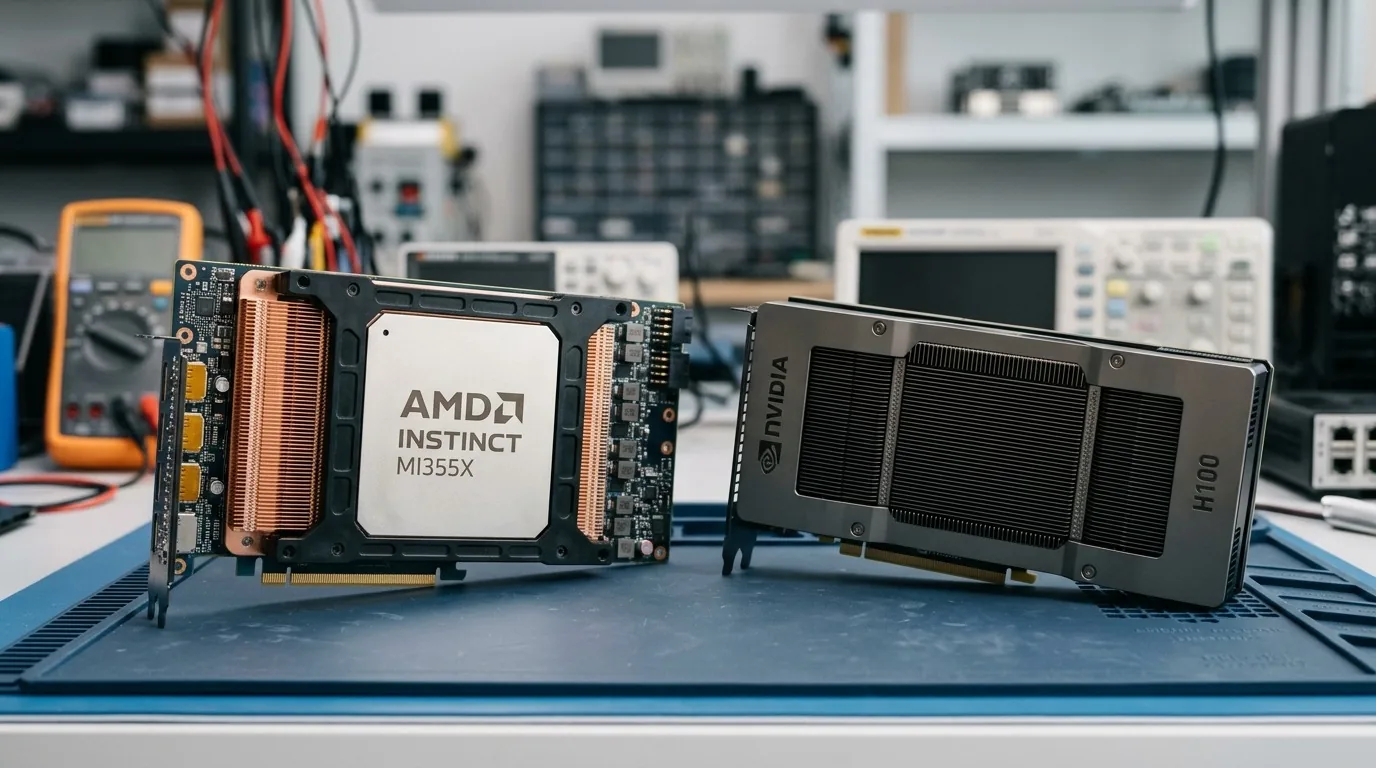
AMD‘s AI Agent benchmark results landed Wednesday on the Artificial Analysis AA-AgentPerf index, putting its MI355X accelerator chip against Nvidia hardware on that specific test for the first time.
Key Takeaways
- Artificial Analysis added AMD’s MI355X accelerator to its AA-AgentPerf index alongside new DeepSeek V4.1 Flash results
- AA-AgentPerf measures chip speed and cost for AI agents completing multi-step tool calls and reasoning tasks
- The MI355X was compared with Nvidia hardware on workloads including Kimi K3, GLM-5.2, GLM-5.3 and DeepSeek V4 Pro
- Nvidia disclosed a $250 million commitment to agentic safety research in the United Kingdom on Wednesday
Benchmark firm Artificial Analysis said on X that alongside new DeepSeek V4.1 Flash results, it added the MI355X to AA-AgentPerf for models including Kimi K3, GLM-5.2, GLM-5.3 and DeepSeek V4 Pro, comparing the chip’s output against its latest Nvidia results on the same workloads. The index measures how AI chips perform when running multi-step agent tasks rather than single-prompt responses.
AA-AgentPerf tests how fast and how cheaply a given chip can run an AI Agent through a realistic chain of tool calls and reasoning steps, rather than the single-token throughput numbers chipmakers typically publish themselves.
That distinction matters because deployment economics turn on available capacity, power draw and cost per unit of inference, not peak token claims alone.
Why AI Agent Workloads Need A Different Yardstick
Traditional chip benchmarks measure how many tokens a GPU can generate per second on a static prompt, a number that tells buyers little about running an AI Agent that calls external tools, waits on results and reasons across many steps. The constraint is physical, memory bandwidth, available capacity and power can matter more than a headline throughput figure.
Agentic workloads, where a model plans, executes and checks its own work in a loop, punish chips differently because the bottleneck often shifts from raw compute to memory bandwidth and how quickly a chip can switch between tasks.
That is the gap AA-AgentPerf is built to expose, and it is why adding the MI355X matters more than a single new line on a spreadsheet.
Also Read: HCLTech Becomes Anthropic’s Top Claude Partner, Builds New AI Business Unit
AMD has spent 2026 pushing its Instinct accelerator line as a credible alternative to Nvidia’s dominant position in AI training and inference hardware. Independent, apples-to-apples benchmarks are scarce in a market where most performance claims come from the chipmakers themselves, which is part of why Artificial Analysis has become a reference point cited by enterprise buyers weighing a multi-vendor chip strategy instead of staying locked to one supplier.
What A Credible Second Source Would Mean For Buyers
Nvidia currently supplies the overwhelming majority of AI training and inference silicon, a concentration that leaves cloud providers and AI labs exposed to a single vendor’s pricing and supply decisions.
The supply constraint is not theoretical, scarce capacity can quickly become the more important variable than a vendor’s stated strategy.
A credible AMD alternative validated on neutral benchmarks like AA-AgentPerf gives buyers leverage in price negotiations and a hedge against Nvidia capacity shortages, which have periodically constrained the market through 2026. That leverage will depend on whether AMD can translate benchmark results into available capacity and competitive cost per unit of inference.
Nvidia itself has continued expanding into adjacent markets this week, including a $250 million commitment to agentic safety research in the United Kingdom, disclosed Wednesday, underscoring how much ground AMD still has to cover on reputation and ecosystem lock-in even as its raw numbers improve.
The real test comes from how the MI355X numbers compare once Artificial Analysis publishes the full head-to-head data rather than the teaser posted Wednesday.
Watch for AMD’s own response and for whether major cloud providers cite these numbers when announcing new MI355X deployment commitments in the coming weeks.
Read Next: OpenAI Spent £2.3M Per UK Employee In 2025 As Revenue Hit £293M