IPhone Maker Foxconn Bundles Nvidia Systems So Firms Start Sooner
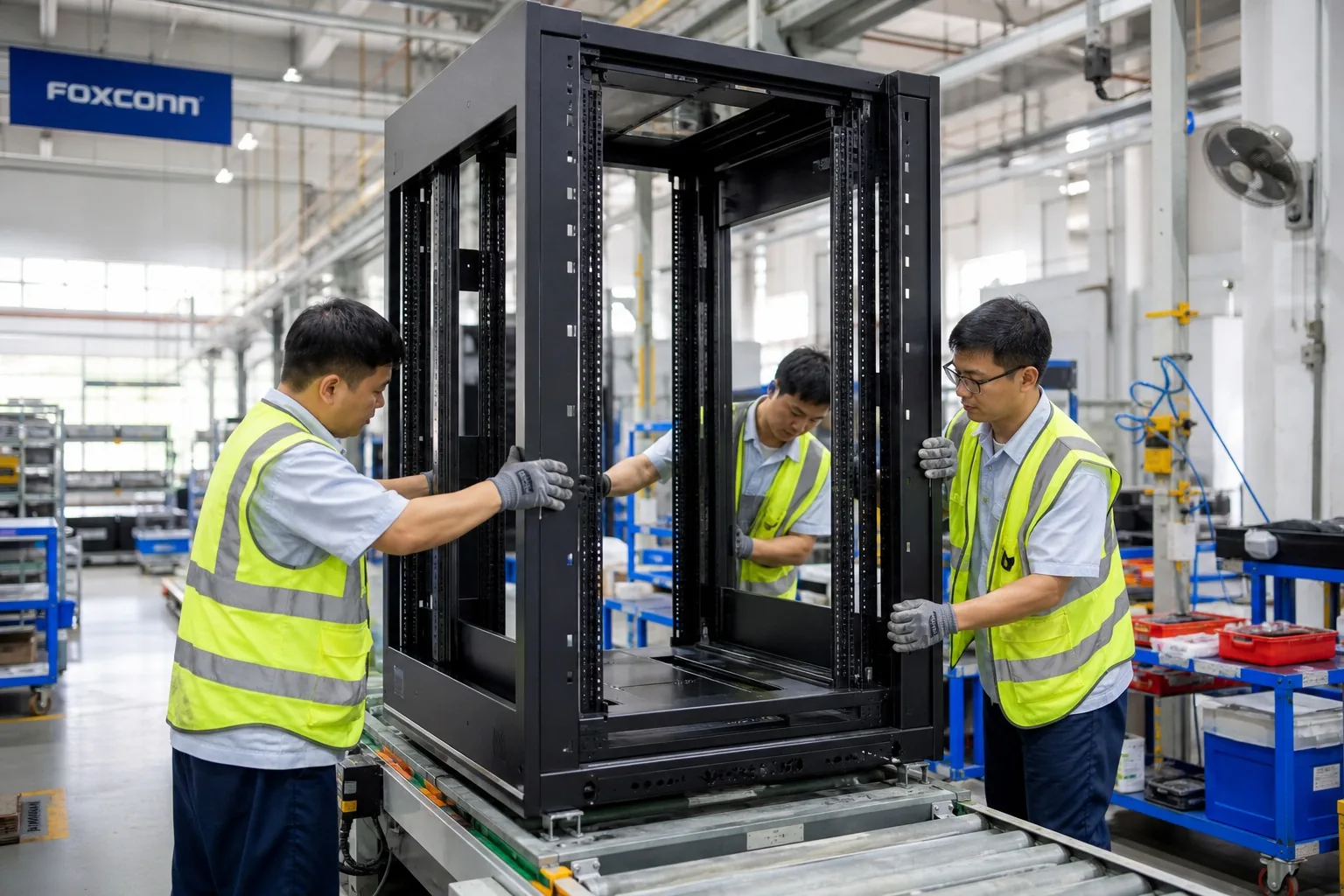
Foxconn, the company best known for making iPhones, unveiled ready built Nvidia AI server racks and software to help businesses get new systems running faster with less on site setup.
Key Takeaways
- Foxconn unveiled two AI infrastructure debuts at Hon Hai Tech Day. An Nvidia DSX POD reference design and a token-focused software stack
- Foxconn described the package in parallel French and Portuguese releases that framed the concept as a token factory and standardized scaling path
- The token factory pitch changes sales by telling customers to think in finished AI work, not installed hardware
- A pre-integrated DSX POD design promises less field assembly and fewer failure points after hardware arrives
Foxconn described the package in parallel releases, and the French said the concept offers a standardized path for partners to pre-integrate and scale AI infrastructure, while the Portuguese used the same token factory framing.
Foxconn is the contract manufacturing giant formally known as Hon Hai Precision Industry, and it has spent the past year trying to turn AI infrastructure into a repeatable hardware business rather than a custom systems job. The phrase “token factory” matters because AI buyers increasingly measure value by how many usable output tokens a system can produce at a given cost, latency and uptime level.
Token Factory Shifts The Sales Pitch
For years, AI infrastructure deals were sold as raw compute.
Buyers asked how many GPUs, how much memory and how much power a rack could support. A token factory pitch changes the unit of sale by telling customers to think in finished AI work, not installed hardware.
That fits the way enterprises actually consume models.
A customer support bot, coding assistant or document parser does not care how many chips sit in a cabinet. It cares how many prompts and responses clear within a service target.
By tying factory-built hardware to software orchestration, Foxconn is trying to sell a production system, not a box of parts.
The factory-built DSX POD angle also attacks one of the worst frictions in AI buildouts. Partners often lose weeks validating cooling, networking, firmware and cabling after hardware arrives.
A pre-integrated design promises less field assembly and fewer failure points.
How Foxconn Turns Custom GPU Clusters Into Repeatable Racks
This approach follows a broader shift across AI infrastructure. Early GPU clusters were often bespoke, assembled for a single hyperscaler or lab.
As enterprise demand widened, vendors started chasing reference designs that could be reproduced faster across customers and geographies.
That is why Foxconn’s manufacturing pedigree matters here. The company is not only selling assembly capacity.
It is trying to make AI system integration look more like consumer electronics production, where validated designs can be repeated at scale with predictable cost and timing.
Also Read: Europe Banking Giant Credit Agricole Gives 2 AI Firms The Keys
The timing also lines up with tighter buyer scrutiny. Customers that rushed into GPU procurement in 2025 and early 2026 now want proof that the spend converts into inference throughput and application revenue.
Why Tokens Became The New Factory Output
In Foxconn’s framing, the token factory model treats text generation the way an industrial plant treats units off a line.
Each token is a small slice of model output, and millions or billions of tokens add up to the usable capacity behind chat, search and agent tools.
That is more specific than saying a cluster has a certain number of GPUs, because a fast cluster can still produce poor economics if orchestration is weak or jobs sit idle. For companies building around Nvidia hardware, this changes procurement language, a chief information officer can compare systems by response throughput, queueing behavior and cost per generated token, not just by chip count.
For AI service providers, it also opens a path to fixed-price contracts tied to delivered output.
What comes next is whether Foxconn can turn the phrase into customer wins. Token factory only becomes real when buyers start signing around token throughput guarantees, factory lead times and pre-validated rack performance.
Analysis Capacity, Supply And The Hints In Spending
Framing products around tokens clarifies the right operational metrics, including physical capacity (GPU count and rack density), supply chain lead times for parts, power and cooling requirements, and the realized cost per inference token under sustained load.
These are the constraints that determine whether a “factory” can actually deliver predictable throughput at scale.
When corporate strategy and capital spending diverge, public behavior should be judged by the spending. Large-scale, repeated investments in validated rack production and logistics signal a commitment to volume and predictable unit economics more than press releases do.
If Foxconn’s factories are genuinely set up to repeat designs and reduce field validation, that should lower per-token costs by improving utilization and reducing integration failures.
But capacity alone is not the full story. Power and cooling limits, the availability of high-performance GPUs, and the software orchestration that keeps chips busy during diverse workloads all affect cost per usable token.
A reference design helps only if it is matched to a predictable supply of components and a commercial model that aligns revenue to throughput guarantees.
Without those, the token factory remains a promising framing rather than a delivered advantage.
Read Next: Free AI From A Startup Reads Photos And Text On Ordinary Laptops