AI Hardware Startup Positron Wins A Buyer That Promises To Come Back For More
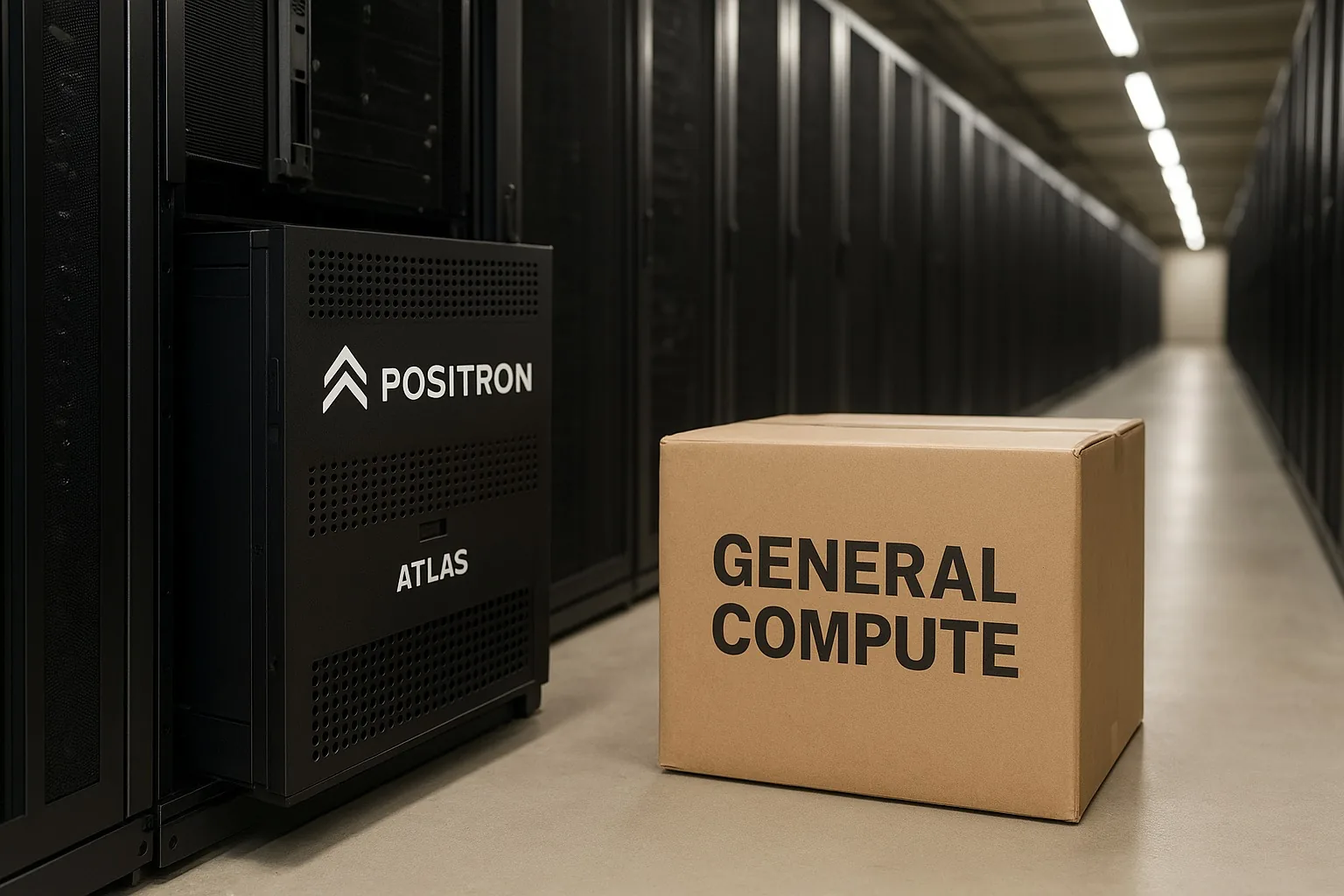
AI hardware startup Positron has won an order from AI computing firm General Compute, which will buy its Atlas machines for running AI models and has promised more purchases, though neither gave a price.
Key Takeaways
- Positron AI said General Compute will buy Atlas inference systems and commit to additional future purchases
- The companies did not disclose the deal value or unit count
- Positron builds inference systems, while General Compute sells and deploys AI infrastructure for customers needing capacity without designing chips
- Memory bandwidth is the overlooked bottleneck in model serving because large models repeatedly fetch parameters from memory
Positron announced the deal in a company release. The company builds inference systems, which are machines tuned to run trained models for end users, while General Compute sells and deploys AI infrastructure for customers that need capacity without designing their own chips.
The companies did not disclose the deal value or unit count.
Positron Deal Terms And Commitment
They did say General Compute committed to buying Atlas systems and future capacity, which makes the announcement more concrete than a loose reseller agreement.
That matters because inference has become the expensive half of AI for many commercial users. Training a model is a giant one-time job.
Serving that model is the recurring cost that hits every user query, every customer support session and every generated report.
The startup’s pitch is that standard GPU systems waste money when large models spend more time pulling weights from memory than doing arithmetic. If that is true, a system designed around memory movement can answer more requests per dollar even without winning every raw benchmark.
Memory bandwidth is the overlooked bottleneck in model serving.
Large language models store billions of parameters, and each generated token requires the system to fetch many of them again. When the chip waits on memory, adding more compute units does not help much.
That is why startups now market inference boxes with different memory layouts, custom interconnects and narrower goals than the general-purpose GPU stack.
Also Read: Agent Memory Overtakes Full Context With 16 Tokens In Real FactKG Test
Market Timing And Economics
The timing also fits a wider buyer reset. Enterprises rushed into GPU reservations during the first wave of generative AI, then discovered that interactive products live or die on unit economics.
If a cheaper inference path works, it opens room for lower-priced copilots, internal tools and edge deployments that could not support premium cloud serving fees.
General Compute gives the startup a proving ground outside the lab. Customer deployments expose problems that polished benchmarks hide, including queue spikes, prompt length variation and the ugly mix of small and large requests that real traffic creates.
Earlier infrastructure stories focused on securing access to chips and power.
The next contest is about matching hardware to the right workload. Atlas enters that phase as a specialized bet that many production models are memory-bound, not purely compute-bound.
Why Memory First AI Changes Serving Economics
memory-first AI starts from a simple observation that Positron AI is betting on.
Many large models do not spend most of their time doing math. They spend time waiting for parameters to move from memory into the chip.
If that delay dominates, then a faster arithmetic engine alone will not cut latency or cost.
That is why Atlas is framed as an inference system, not a universal AI computer. General Compute can place it where steady model serving matters more than training flexibility. The next thing to watch is whether the company publishes throughput, latency and watt figures from customer deployments.
Those numbers, more than marketing language, will show if memory-first AI can take real budget from the GPU incumbents.
Read Next: Reply Wins Nvidia’s Physical AI Badge, Letting Factories Test Robots Before They Buy