Google DeepMind’s Watermarked AI Proteins Pass Real Lab Binding Tests
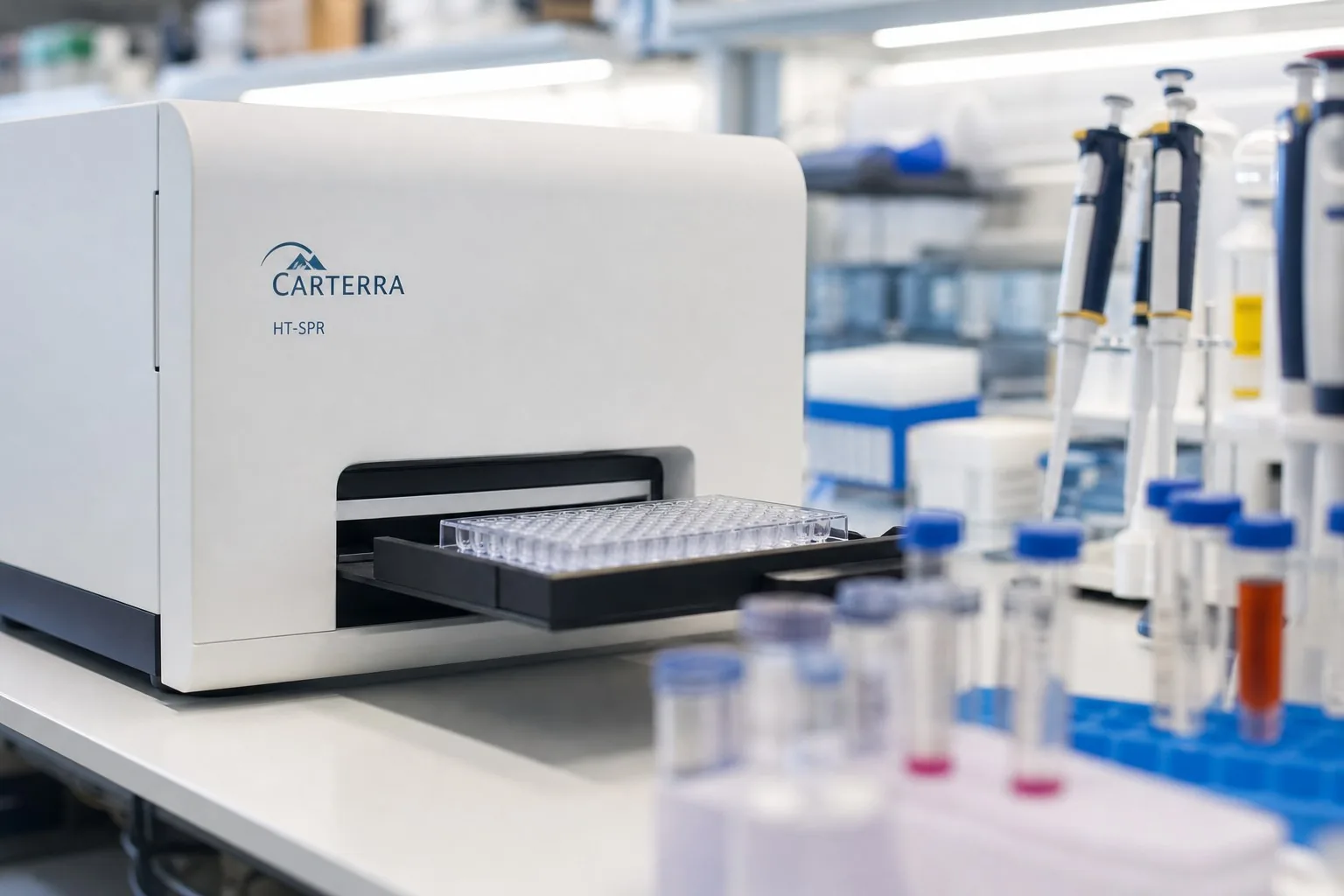
Google DeepMind reported that AI-designed proteins carrying an invisible digital watermark held up under real laboratory testing, according to a study published in Nature and validated using Carterra‘s HT-SPR binding platform.
Key Takeaways
- Google DeepMind reported that AI-designed proteins with digital watermarks held up under laboratory testing in a Nature study
- Carterra’s HT-SPR platform supplied binding data to confirm protein designs and train further models
- The watermark is a traceable pattern embedded in a protein’s amino acid sequence that can be detected computationally later
- Carterra’s validation covered one binding scenario, requiring further testing across protein families and design pipelines
The company said that the watermarking method survived testing against experimental binding data, the measurements scientists use to confirm whether a designed protein actually attaches to its intended target molecule.
Carterra’s surface plasmon resonance, a technique that tracks how light reflects off a sensor surface to detect molecules binding in real time, supplied the binding data the researchers used to confirm their designs and train further models.
The result speaks to a specific experimental question, whether the watermark preserved binding behavior, rather than establishing performance across every protein design setting.
A watermark in this context is a deliberate, traceable pattern embedded in a protein’s amino acid sequence that does not disrupt the molecule’s function but can be detected computationally later.
For AI-generated proteins, the technique works like a signature baked into the design itself rather than attached as a separate label, so it survives synthesis, purification and lab handling.
The practical test was whether a watermarked protein still bound its target as reliably as an unmarked version would, since adding a traceable pattern risks interfering with the exact molecular shape that determines binding behavior.
Carterra’s HT-SPR platform let the team measure that binding affinity directly rather than relying on computational prediction alone, closing the loop between a model’s design and its physical behavior in a lab.
Also Read: OpenAI Revenue Surges Q3, Firstadopter Rebuts AI Shortfall Fears
Why Google DeepMind’s Protein Watermarks Matter To Biosecurity Researchers
DeepMind joins Anthropic and other AI labs whose protein and molecule design work depends on exactly this kind of experimental binding data to confirm whether computational predictions hold up outside a simulation.
Tools in its AlphaFold lineage have made it dramatically cheaper to generate novel protein candidates, accelerating drug discovery but also raising concern among biosecurity researchers about traceability if the same tools were misused.
A traceable watermark gives researchers, and potentially regulators, a way to confirm a protein’s AI origin after the fact, similar in spirit to watermarking schemes already deployed for AI-generated text and images, but applied to a physical molecule rather than a digital file.
From Text Watermarks To Molecular Ones
AI labs have spent the past two years building watermarking systems for generated text and images to combat misuse, and the company’s SynthID tool for images and audio has been one of the more visible efforts. Extending the same traceability concept to physical proteins marks a harder technical problem, since the watermark has to survive not just digital copying but actual chemistry.
What Comes Next For Protein Traceability
Carterra’s validation covers one binding scenario.
Broader adoption would require testing across many more protein families and design pipelines beyond the developer’s own.
The binding result is a useful experimental check, but it leaves the question of how the watermark performs across those additional protein families and pipelines. Biosecurity researchers will likely push for the watermarking method to become a standard check before AI-designed proteins move toward clinical or commercial use.
Read Next: Tokenized Stocks Hit $3.9B Market Cap As BNB Chain Grabs A Massive $1.2B Share