AMD Helios Rack System Makes Brutal Bid to Dethrone Nvidia
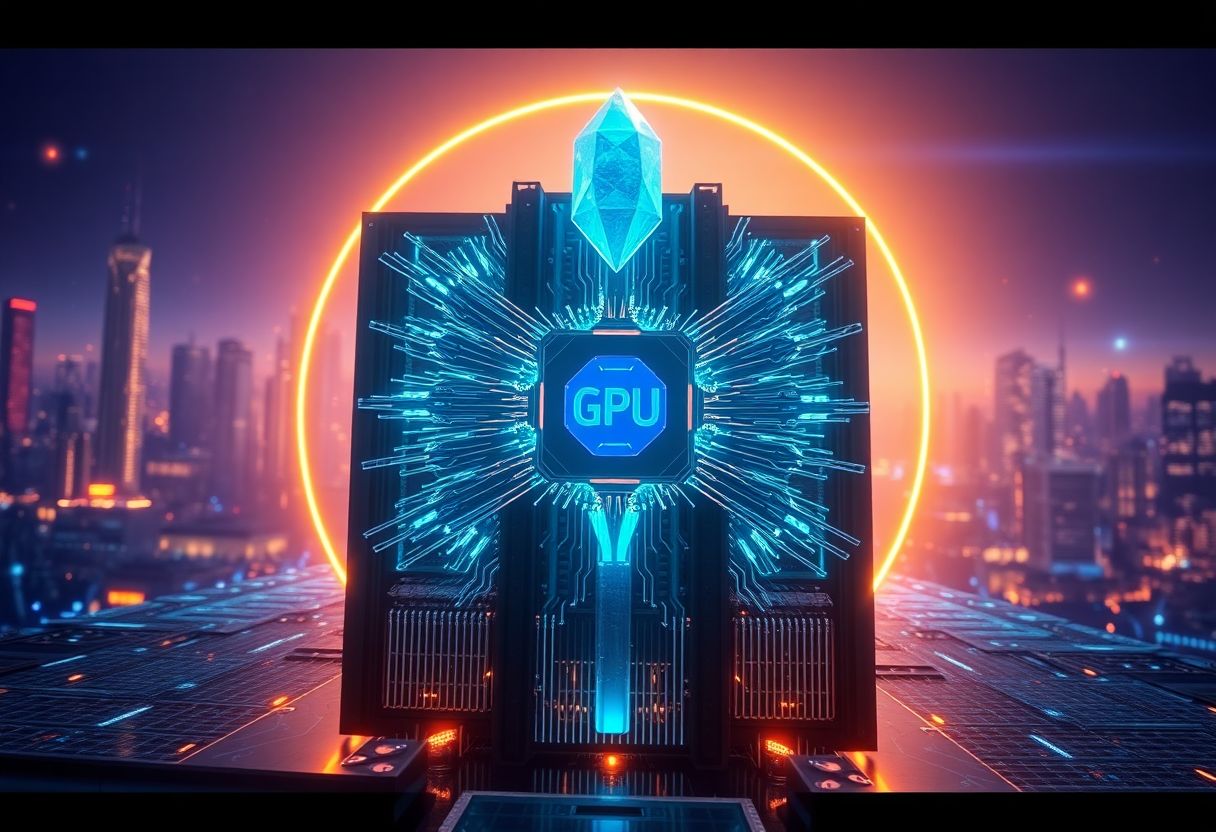
AMD took the wraps off its Helios rack system on Thursday at a San Francisco event — a single chassis housing 1,152 of the company’s new MI450 GPUs.
It’s the clearest signal yet that AMD wants a fight with Nvidia in the one market Nvidia has owned outright: the hyperscale AI data center.
Helios didn’t arrive alone. The launch landed alongside AMD’s previously announced $5 billion investment in Anthropic, and the company is framing both as a single coordinated move into the compute layer Nvidia has dominated for four straight years.
That framing came via Fortune, which covered the Helios debut Thursday and treated the Anthropic investment as part of the same strategic message.
AMD (AMD) sees them as complementary pieces of one infrastructure ambition.
AMD Helios Rack Targets Nvidia’s Core Advantage
The AMD Helios rack is a complete infrastructure unit, not just a GPU.
It integrates power delivery, liquid cooling, networking fabric, and the MI450 accelerators into a single system that data center operators can deploy without separately sourcing every component.
That integrated-rack model is the same strategy Nvidia pursued with its GB200 NVL72 product line, which bundles 72 Blackwell GPUs in a liquid-cooled rack. The Helios system’s 1,152-GPU figure dwarfs that count, though raw GPU numbers are not a direct proxy for performance, since architecture, interconnect bandwidth, and memory capacity all shape real-world throughput.
The MI450 GPU uses AMD’s latest CDNA architecture.
CDNA, which stands for Compute DNA, is a chip design lineage AMD created specifically for data center AI workloads, distinct from the RDNA architecture it uses in consumer graphics cards. Each MI450 connects to neighbors through AMD’s Infinity Fabric interconnect, allowing the full unit’s GPUs to share memory and divide large model computations across the chassis.
A $5 Billion Partnership Changes the Calculus
The Helios launch does not arrive in a vacuum.
AMD committed up to $5 billion in a deal with Anthropic that will deploy MI450 GPUs at gigawatt scale across Anthropic’s training infrastructure. That agreement, covered in depth by Fathom on July 22 this year, transforms the MI450 from a speculative product to one with a committed anchor customer.
Anchor customers matter enormously in the chip industry.
Nvidia’s dominance was partly built on early, deep relationships with Google, Microsoft, and Meta, which gave it volume guarantees that funded further R&D. AMD securing Anthropic signals that at least one frontier AI lab is willing to build serious infrastructure around non-Nvidia silicon, which is a qualitative shift from prior cycles where AMD captured marginal share.
Anthropic is training models that compete directly with OpenAI’s GPT series.
Running that training on AMD hardware at scale is an uncontrolled real-world test of whether the MI450 can match Nvidia’s H100 and B200 for model quality per dollar spent.
Why the Data Center Rack Has Become the Unit of Competition
The shift from selling individual GPUs to selling complete rack systems reflects a change in how AI compute is actually purchased. Hyperscalers and cloud providers do not buy chips one at a time.
They buy capacity in megawatt blocks, and they want to know that power, cooling, networking, and compute arrive pre-integrated and validated.
Nvidia understood this early. Its NVL72 rack system, which Fathom covered when Nvidia announced the Vera Rubin architecture last month, demonstrated that a GPU vendor willing to take responsibility for the full system could command higher margins and smoother procurement cycles.
AMD is following that template with the Helios platform.
The risk for AMD is software, not hardware. Nvidia’s CUDA programming platform has been the standard for AI model training since roughly 2012, and most training frameworks, libraries, and optimization tools are written to run on CUDA first.
AMD’s ROCm software stack is a functional alternative, but developer familiarity and third-party tool support still lag.
Anthropic’s engineering team will need to either port existing workflows to ROCm or run them through compatibility layers, which adds engineering cost and potential performance overhead.
From Challenger Chip to Infrastructure Standard
The question now is whether this system represents a sustainable wedge into Nvidia’s position or a high-profile product that struggles to find buyers beyond Anthropic.
The GPU market is currently supply-constrained in Nvidia’s favor. Lead times on H100 and B200 units remain long, and enterprises unable to secure Nvidia allocation have begun evaluating alternatives more seriously than they did two years ago.
That demand overhang creates a real opening for AMD, provided ROCm compatibility holds.
Vertiv, which builds the power and cooling infrastructure that surrounds GPU racks, announced Thursday that its systems are already supporting Nvidia AI compute deployments at the Naval Postgraduate School. That deployment shows how quickly defense and research institutions are consuming AI infrastructure.
AMD will want to reach those buyers too with the AMD Helios rack.
AMD has never led the AI chip market. It has, historically, captured share by undercutting Nvidia on price while closing the performance gap incrementally.
The Helios system and the MI450 represent a more aggressive posture, pairing competitive hardware with a landmark enterprise deal. Whether that combination shifts the market’s center of gravity will be visible in hyperscaler procurement decisions over the next two quarters.
Read Next: Nvidia Nemotron AI is First to Outscore Humans at IOI 2026