Chef Robotics Moves Food-Prep Arms From Pilot Kitchens to Live Lines on Nvidia Isaac
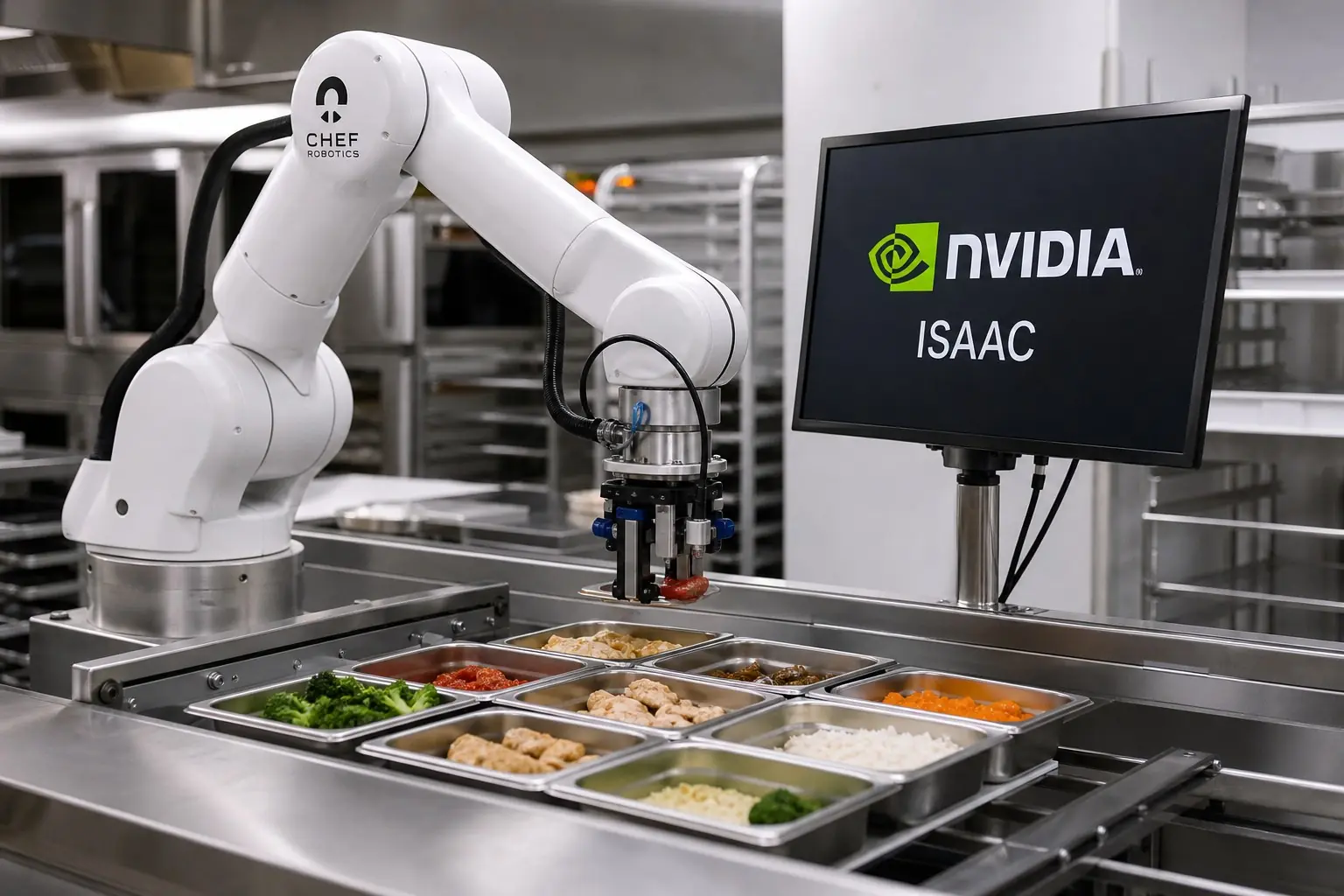
Chef Robotics is moving its food-handling robot arms, trained in simulation on Nvidia‘s Isaac platform, out of pilot kitchens and onto live food production lines.
Key Takeaways
- Chef Robotics is expanding food-manipulation robot deployments built on Nvidia’s Isaac platform
- Nvidia Isaac lets engineers train and test robot behavior in simulated factory replicas before deploying code to physical hardware
- Chef Robotics sells robotic arms and software to food producers seeking flexible automation without re-engineering kitchen layouts
- Chef Robotics did not disclose specific accuracy or uptime figures from its live deployments
Chef Robotics said it is expanding deployments of food-manipulation robots built on Nvidia‘s Isaac platform, using simulation, digital twins and motion-planning tools to automate tasks that have resisted robotics for decades.
The company said its robots now run customer deployments that depend on Nvidia’s simulation and motion-planning technologies to handle food items that vary in shape, weight and texture, a challenge that has historically limited automation in food-production lines.
Nvidia Isaac is a robotics development platform that lets engineers train and test robot behavior inside a simulated replica of a factory floor, called a digital twin, before deploying code to physical hardware. That approach cuts the risk and cost of testing directly on production lines, where a single failed grip can halt an entire shift.
Food manipulation is a notoriously hard robotics problem because ingredients are soft, irregular and inconsistent, unlike the rigid, uniform parts robots typically handle in auto or electronics assembly.
Also Read: AI Image Generation Launch Offers Six Directions For One Envato Credit
A protein cutlet or a scoop of rice does not behave the same way twice, which is why most food-packing lines still rely on human labor for final assembly steps.
Chef Robotics has built its business specifically around that gap, selling robotic arms and software to food producers who need flexible automation without re-engineering their entire kitchen layout.
Nvidia’s Broader Push Into Physical AI
The Chef Robotics deployment lands alongside a wave of Nvidia-linked announcements this week, including new agentic AI workstations from Dell and a UK sovereign compute deal through Civo. Nvidia has spent much of 2026 positioning Isaac and its Omniverse simulation tools as the default layer for industrial robotics, competing with offerings from Google DeepMind‘s robotics research and smaller simulation startups.
Chef Robotics’ expansion gives Nvidia a concrete commercial reference point in the food sector, an industry with thin margins and high labor turnover that has been slower than automotive or warehousing to adopt robotics.
What Happens If The Line Jams
Food manufacturers will be watching failure rates as closely as throughput gains.
A digital twin can predict most mechanical issues, but food-grade hygiene rules, allergen cross-contact risk and rapid menu changes remain variables that simulation alone cannot fully model. Chef Robotics did not disclose specific accuracy or uptime figures from its live deployments.
Read Next: Talks To Raise Investment At Higher Valuation After $600M Round