What 208B Transistors Inside Nvidia’s Blackwell Chips Really Mean
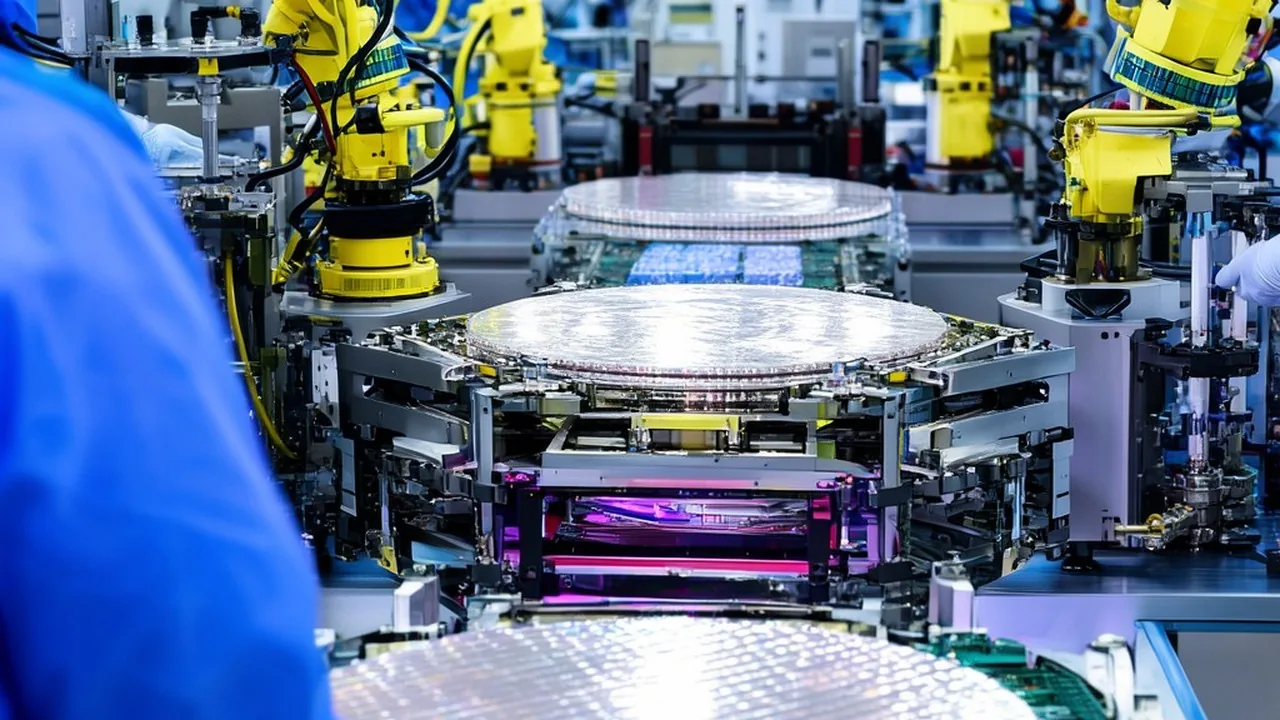
Nvidia‘s Blackwell architecture packs 208 billion transistors into its graphics chips, and how many reach buyers depends on scarce chip-factory capacity, advanced packaging and US export rules.
Blackwell makes each chip far more powerful, but it leans even harder on things that are already in short supply: the most advanced chip factories, the plants that assemble chips into finished systems, electricity, networking gear and government export licenses. Export rules now come with hard numbers too, such as a U.S. approval letting two Gulf companies each buy the equivalent of up to 35,000 GB300 chips.
TL;DR
- What limits how big AI models can get is not one chip, one company or one cloud. It is a chain of shortages, from chip factories and chip assembly to networking, power and export rules, and any one link can hold up the rest.
- Blackwell architecture lets Nvidia pack more computing power into each system, but that makes buyers even more dependent on TSMC’s factories, scarce memory and assembly capacity, and a handful of giant cloud companies that buy most of the chips.
- Demand for AI computing power is not in doubt. The real question for 2027 is which link in the chain gives way first.
Why The AI Chip Shortage Is Really Five Shortages
People talk about an “AI chip shortage” as if it were one problem. In practice, the biggest AI models can stall for at least five different reasons.
The first is the chip factories themselves, since only a few can make the most advanced chips. The second is assembly: advanced chips have to be packaged with fast memory and then built into server racks. The third is networking, the cables and switches that let thousands of chips work as one machine, which matters more than any single chip’s top speed.
The fourth is the data center itself, where the hold-up may be waiting for a power connection or liquid cooling rather than chips. The fifth is allocation: who gets served first when every step above is short of capacity.
These risks add up. If each of the five steps is 90% reliable, the whole chain is not 90% reliable; multiplied together, it is closer to 59%. One delay rolls into the next budget, the next model launch and the next round of orders. Company filings and risk warnings show firms are planning around this whole chain of risks, not blaming delays on a single missing chip.
What Blackwell Architecture Changes, And What It Doesn’t
Nvidia’s Blackwell architecture is the best-known symbol of the AI boom. Its data center chips contain 208 billion transistors and are made on a custom version of TSMC’s 4NP manufacturing process, Nvidia said. That number says two things at once: each chip can do far more work, and all of that work depends on one manufacturer.
Nvidia pitches Blackwell as built for an “age of AI reasoning,” not just for training models. That matters because one chip family now has to serve two kinds of demand at once: training new models, and running them for users, which is known as inference.
Rather than replacing old demand, it stacks the two together. AI labs want bigger training runs. Cloud providers want chips to run chatbots and apps. Big companies want guaranteed access. Governments want national AI data centers. The same supply chain is expected to serve all of them.
Faster chips do not automatically mean fewer chips are needed. When computing gets cheaper, people use more of it: more experiments, bigger models and more copies running for users.
Blackwell also raises the stakes for everything around the chip. A slow network, too little memory, racks that need more power than the building can supply, or a cooling failure all waste more money when each chip does more work.
There is also a changeover period. Buyers often keep running clusters of Hopper, Nvidia’s previous chip generation, while saving Blackwell architecture systems for their next projects. With two generations in use at once, demand for assembly, circuit boards and installation crews goes up, which makes the shortage look even worse.
Only A Few Factories Can Make These Chips
The deepest problem is that only a few chip factories, known as foundries, can make the most advanced chips at scale, and TSMC leads them. TSMC’s newest process, N2, started mass production in the last three months of 2025, TSMC announced. That shows TSMC is moving forward on schedule, not that there is suddenly plenty of spare capacity.
AI chips now take up the most valuable share of the most advanced factory capacity, while phone chips, computer processors, networking chips and custom AI chips from other companies compete for the rest. On its first-quarter 2025 earnings call, TSMC management took questions on whether demand would keep its advanced factories fully busy, TSMC reported.
Nvidia admits the dependence openly. Its annual report for fiscal 2026 says its ability to make more chips depends on how fast its manufacturing partners can ramp up production, Nvidia disclosed. In other words, even the market leader does not control its own supply.
Relying on so few factories creates three practical risks. First, delays: one slip at a factory, an assembly line or a testing step pushes back shipments further down the chain. Second, pricing power: the biggest buyers, who sign the longest contracts, lock in supply years ahead while smaller labs wait. Third, switching is hard: data centers built around one chip, its software and the network that connects the chips cannot easily change course halfway through.
That is why computing power is not a simple off-the-shelf purchase for AI labs. Once a lab picks its setup, it is stuck with that setup’s supply risks.
Most coverage counts chips shipped, but what really matters is how many complete, working systems are running. A chip is useless until it becomes a reliable part of a cluster, the large group of connected servers that trains or runs AI models.
That puts the focus on packaging (attaching each chip to its memory), circuit boards, server assembly and the high-speed network between machines. These steps are spread across many suppliers and rarely get the attention of a big chip launch, but they are where chips on paper turn into computing power that can actually be used.
The biggest AI training runs need thousands of chips talking to each other with almost no delay, a network that rarely goes down, and enough installers to turn deliveries into working clusters quickly. If packaging or networking parts fall behind, chip output overstates how much computing power is really available. Blackwell architecture makes this worse because powerful systems punish any weak link: a top chip on a slow network wastes expensive time, and racks waiting for a building upgrade just sit in storage until the power arrives.
MLPerf, the industry’s main speed test for AI hardware, measures whole systems rather than single chips, MLCommons said. MLCommons, the group behind MLPerf, also added Meta’s Llama 3.1 405B, a very large AI model, to its training test, a sign that public testing has moved up to the biggest models, MLCommons announced. The tests suggest buyers care more about how much work a complete setup delivers than about any one part’s specs, which gives the edge to whoever can secure every component and get systems running fastest.
Smaller cloud companies can stay short of chips even when headlines say more chips are shipping. New chips may go first to buyers who already booked packaging, installation and networking. Chip production can rise while the computing power available to rent stays tight.
Also Read: That broader stack is why the Forget GPUs, A Memory Chip Squeeze Could Choke AI Even After OpenAI’s $250B Splurge matters alongside GPUs, especially when one missing component can idle an otherwise complete rack.
Big Tech Spending Buys A Place In Line, Not Protection
Huge spending by the biggest cloud companies, known as hyperscalers, such as Amazon, Microsoft and Google, has changed the shape of the shortage. It has not ended it.
These companies are both customers and gatekeepers. They reserve chips from chipmakers, build data centers, rent computing power to other companies and sometimes build their own AI models that compete with the labs renting from them. In a tight market, that position is an advantage, but it is not protection.
Richer buyers can pay to reserve chips earlier, sign long-term electricity deals and build faster. But they still face construction delays, parts shortages and changing government rules. Money can buy a place ahead of rivals. It cannot instantly create more advanced chips or more connections to the power grid.
For AI labs, that means even well-funded ones can depend on how a cloud company decides who goes first. If a cloud has to choose between a big business customer, its own model launch and an outside lab’s training job, they will not get equal treatment. The shortage then shows up as waiting lists rather than headlines.
When a few buyers take most of the top AI systems, access can become more concentrated even as total supply grows. There may be more clusters overall, but not more organizations with reliable access to the best ones.
That could change who leads in AI. The next gap between model makers may come not only from smarter techniques but from who has steady access to enough reliable computing power to keep improving and running their models.
Export Rules Decide Where The Chips Go
Government policy is not separate from the chip shortage. It is one of the things that decides where scarce systems end up.
In November 2025, the U.S. Commerce Department cleared two Gulf AI companies, G42 in the UAE and Humain in Saudi Arabia, to each buy the equivalent of up to 35,000 Nvidia Blackwell GB300 chips, The National reported. That is a strikingly specific number. It shows export rules working not just as bans but as rationing, with access granted in chip counts.
Seen as rationing, export rules have two effects. First, chips cleared for one country or buyer are not available elsewhere, so supply can tighten in some places even if factories make just as many chips. Second, the rules can favor big incumbents: large buyers with compliance teams, political connections and long-term contracts tend to get through approvals more easily than newcomers.
In 2023, the Commerce Department also launched a survey of the U.S. chip supply chain, Commerce announced. When governments treat chip supply as a matter of national strength, the result is usually more paperwork, more reporting and less of the market deciding who gets what.
This matters for the biggest AI models because building them is now a geopolitical issue. A large AI data center is no longer just a private investment. It can draw national security attention, export checks and cross-border licensing risk, which makes planning harder and can create artificial shortages on top of real ones.
Running AI Now Competes With Building It
Chips feel scarcer than shipment numbers suggest because demand has changed. The early AI race was mostly about giant training runs to build models. Now there is also inference, running models for millions of users around the clock, plus costly fine-tuning after training and AI agents that carry out tasks on their own. All of these compete for the same hardware.
MLPerf’s training test still measures the cost of building large models, while its inference test measures how efficiently they run, MLCommons published. Together, the tests reflect a market that judges hardware across a model’s whole life: building it, fine-tuning it and serving it to users.
That changes how buyers shop. A cloud company or AI firm may prefer systems that can switch between training and running models, even if they are less specialized. That flexibility sounds safer, but it can make the fight for machine time worse: a cluster meant for research can be pulled into paid customer work when demand spikes, and machines meant for customers can be held back for a big model launch.
Honest test results matter because, when supply is tight, inflated claims lead buyers to spend money in the wrong places. MLCommons recently argued that a benchmark is only trustworthy if it avoids leaderboard tricks and its results can be repeated, MLCommons wrote. If buyers chase flashy scores instead of real-world efficiency, they waste capacity that is already scarce.
The practical result: if demand for running AI grows faster than expected, it can eat into the money and machine time needed to train the next generation of models.
Where The Bottlenecks Sit
Public information is incomplete, but it is enough to see where the risks cluster and roughly how serious each one is.
| Layer | Public figure or indicator | Why it matters | Source |
|---|---|---|---|
| GPU design | Blackwell architecture GPU at 208 billion transistors | A bigger, more complex chip relies more on the factory turning out enough good chips | Nvidia Blackwell architecture page |
| Process node | Custom TSMC 4NP for Blackwell architecture | Ties Nvidia’s top AI chips to a small number of advanced factories | Nvidia Blackwell architecture page |
| Foundry roadmap | TSMC N2 volume production began in 4Q25 | Shows TSMC is moving forward, not that it has lots of spare capacity | TSMC N2 page |
| Policy allocation | Up to 35,000 GB300‑equivalent chips in one approval | Export rules now ration the most advanced AI systems directly | U.S. Commerce BIS page |
| Benchmark scale | MLPerf Training added Llama 3.1 405B | Public speed tests now use the biggest AI models | MLCommons announcement |
| Supply‑chain risk language | Nvidia ties manufacturing growth to ecosystem ramp capacity | Even the market leader says it relies on others | Nvidia fiscal 2026 10‑K |
The key point is not that every step is equally tight. Each one can become the main bottleneck at a different time. When factories are full, chip supply is the limit. When demand surges after a launch, assembly and setup are the limit.
When countries race to build AI data centers, power and cooling are the limit. When rules tighten, government approvals are the limit. People keep looking for one simple explanation because it makes a neat story. The real picture is a shortage that moves from one link to another along a very concentrated chain.
That points to a less glamorous but more realistic view of AI progress: it speeds up or slows down depending on whether enough organizations can keep getting complete, working systems. That is a story about buying and running hardware as much as it is about research.
Methodology
This explainer draws on primary documents, mostly published from 2025 through October 2026, including Nvidia’s Blackwell architecture materials and SEC filings, TSMC investor and technology pages, MLCommons benchmark documents, and U.S. Commerce Department material on chip policy and export approvals.
The aim was to map risk across five steps: chip design, advanced manufacturing, system assembly, data center build-out and government approvals. Public figures were used where they exist, including the 208 billion transistors in Blackwell architecture chips, TSMC’s statement that N2 entered mass production in late 2025, and the approvals equal to 35,000 GB300 chips.
Some evidence is thin. Exact factory allocations, assembly output, supplies of high-bandwidth memory (HBM, the fast memory stacked next to AI chips), how busy clusters are, what cloud companies have reserved, how long power hookups take and where each customer sits in the queue are not fully public. Some conclusions therefore rest on company risk warnings, how benchmarks are designed and policy disclosures, rather than complete shipment data.
The Counterargument
The strongest case against this view is that talk of shortages always lags one step behind reality.
On that view, the market keeps predicting shortages after chipmakers and cloud companies have already committed to fixing them: factories expand, new manufacturing processes ramp up, supply chains move closer to home, clouds overbuild and chips get more efficient. TSMC did start mass-producing N2. MLPerf keeps moving to bigger, more realistic tests.
Nvidia keeps packing more power into each new generation. Cloud giants have shown they will spend their way through bottlenecks rather than wait. If each generation does more useful work per rack, a shortage counted in chips may hide plenty of capacity counted in actual AI output: words generated, training steps completed or tasks finished.
The other fair objection is that buyers may switch. The market may rely less on Nvidia’s chips than critics think: custom chips built by cloud companies, smarter scheduling and techniques that make models smaller or cheaper to run could cut the need for ever-bigger fleets of general-purpose chips. If AI models improve more through better data, training feedback and extra thinking time when answering, the next leap may need fewer giant training clusters than today’s hype suggests.
That case is worth taking seriously, but it does not remove the risk of relying on so few suppliers. It only moves the risk. More efficient software helps until demand swallows the savings. Other chips help only if the software and data centers move with them. New capacity helps only if it arrives before buyers have locked in their place in the old queue.
What To Watch In 2027
The most telling signs next year will come from what companies say about day-to-day operations, not marketing. Watch whether Nvidia and TSMC stop talking about “ramping up” and start talking about “availability,” and whether TSMC hints at real spare capacity rather than careful rationing.
Watch whether MLPerf results show lasting gains that cut the chip time needed to train and run AI models. Watch whether export approvals become standard rules or stay case-by-case deals, because that decides whether policy acts like a tax or a hard barrier.
Most of all, watch the gap between spending announcements and computing power that is actually running. If construction, power hookups and getting full clusters online keep lagging the money, the main limit will stay the hard work of putting systems together, not ambition.
Conclusion
The next limit on the biggest AI models may come from the least glamorous part of the chain: getting complete, government-approved, fully powered systems built around Blackwell architecture. If 2027 brings real spare capacity in factories, assembly and data centers all at once, the ceiling lifts fast. If not, the winners will be the groups that secured their place in line earliest.
Read Next: ZenaTech Unleashes Drones To Hunt Down Delays On AI Data Center Building Sites