Fujitsu Unit 1Finity Says Phone Towers Can Run AI Too
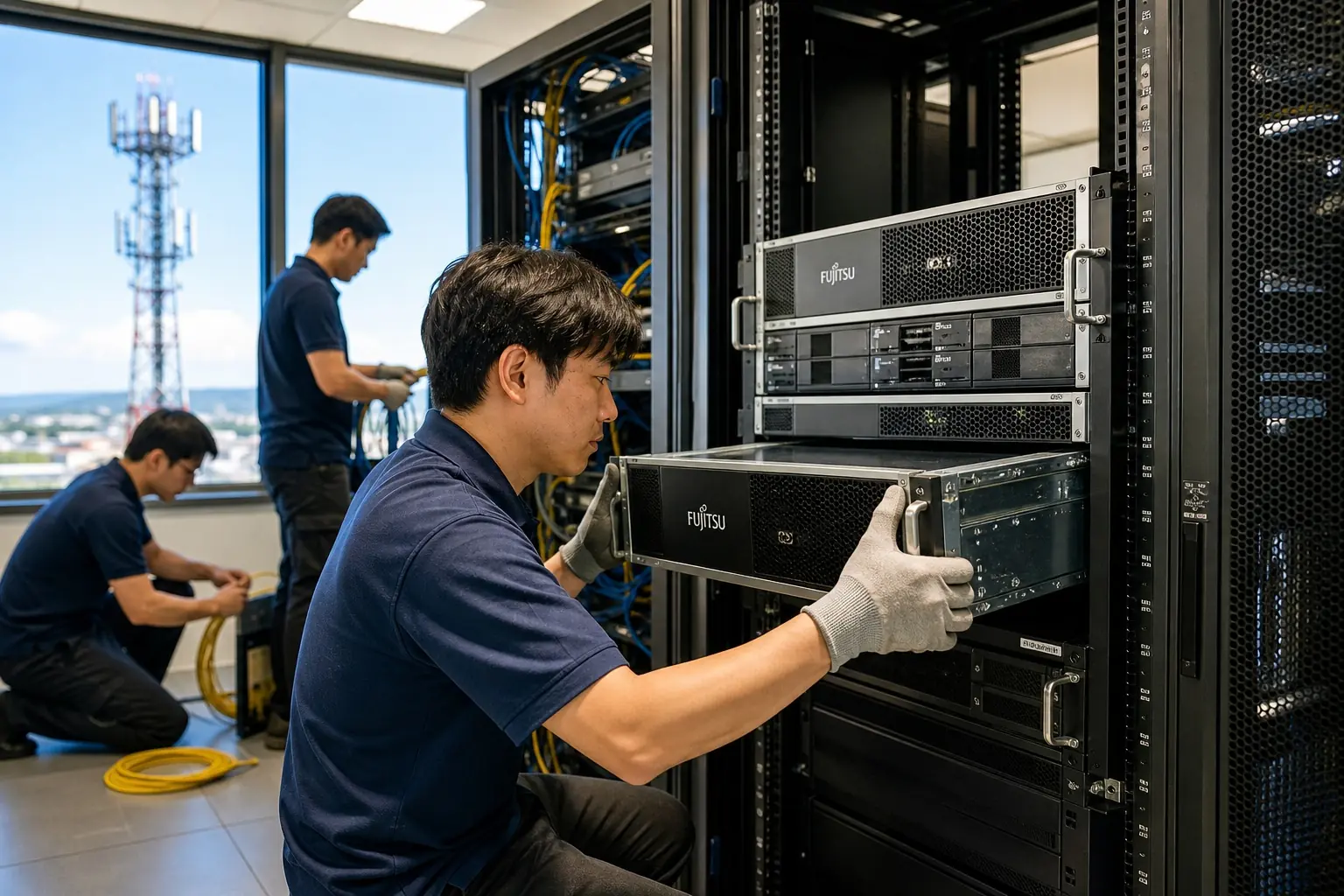
1Finity, Fujitsu‘s telecom gear unit, said its AI-Native VRAN is ready so phone towers can handle mobile service and local AI jobs on the same gear to help carriers make more money.
Key Takeaways
- 1Finity said its full-stack AI-Native VRAN system is now available
- The company said the stack is built on NVIDIA Aerial to virtualize and accelerate radio access workloads
- 1Finity is a Fujitsu unit focused on telecom gear and network software for carriers and large enterprise operators
- 1Finity did not name customers or publish throughput figures in the statement
1Finity announced the release in a company statement, and the company is a Fujitsu unit focused on telecom gear and network software for carriers and large enterprise operators.
The pitch is straightforward, carriers already spend heavily on radio access networks, the hardware and software that connect phones to mobile towers, and many want those sites to do more than pass traffic. AI-Native VRAN tries to turn that fixed cost into a platform for new workloads.
A Radio Network That Can Do Two Jobs
1Finity’s announcement positions its AI-Native VRAN as a way to combine the software-based radio functions vRAN enables with local AI processing, so the same compute footprint can handle both telecom and AI inference tasks.
That matters in edge scenarios where enterprises demand low latency and prefer not to send data to distant cloud regions.
The company frames this as consolidating baseband and AI workloads onto the same infrastructure at tower sites and regional edges, allowing operators to host services such as factory or campus AI alongside mobile traffic while keeping the radio functions protected.
Nvidia Aerial Moves Deeper Into Telecom
1Finity said its stack is built on Nvidia Aerial, a software platform designed to virtualize and accelerate radio access workloads. Aerial uses GPUs and networking software to replace some fixed-function boxes with more flexible compute.
For carriers, that offers a possible revenue argument, not just a cost argument, if a site can serve mobile traffic and also host AI services for factories, campuses or smart city systems, the same rack may earn more.
That promise still depends on scheduling because radio traffic spikes are not optional and any carrier that mixes AI inference with core access functions has to protect the network first.
Also Read: Pika Opens Its Video AI So Studios Can Run It On Their Own Gear
Why Carriers Are Revisiting VRAN Now
Carriers spent the past several years testing open RAN and virtual RAN to cut vendor lock-in and lower upgrade costs, with mixed results because performance and power trade-offs often limited broad rollouts.
This Tuesday release shows the industry is trying a different angle, instead of selling vRAN only as cheaper infrastructure, vendors now pitch it as a path to edge AI revenue, which is a better story for chief executives but raises harder engineering questions about latency, heat, uptime and workload isolation at tower sites and regional edges.
Where AI-Native VRAN Could Stick First
1Finity did not name customers or publish throughput figures in the statement, and without those numbers it is hard to judge whether the first deployments will stay in labs or reach commercial scale fast.
The best early fit may be private wireless networks in factories and ports, where one operator controls the radio environment and can match AI demand to the site, while public mobile networks are larger but less forgiving.
How One Rack Tries To Earn Twice
For 1Finity, AI-Native VRAN is really a utilization story, a carrier tower or edge site already has power, cooling, backhaul and real estate, and if that same site can host AI tasks when radio demand is light, the operator gets more revenue from assets it already owns.
For NVIDIA, the attraction is obvious because telecom is one of the few infrastructure markets large enough to absorb meaningful GPU volume outside the hyperscalers. Nvidia Aerial gives the company a route into carrier budgets without waiting for every operator to build a standalone AI cloud.
The catch is interference. Radio networks need predictable timing, and AI workloads can come in bursts and use a lot of power, so the main technical challenge is running both together while making sure AI never takes away the predictable timing the radio side needs to keep calls and data sessions stable.
Read Next: Supermicro Sells SambaNova Servers For Cheaper Chatbot Replies