New AI Model Drops To 10th With 82.2% On Accounting Work
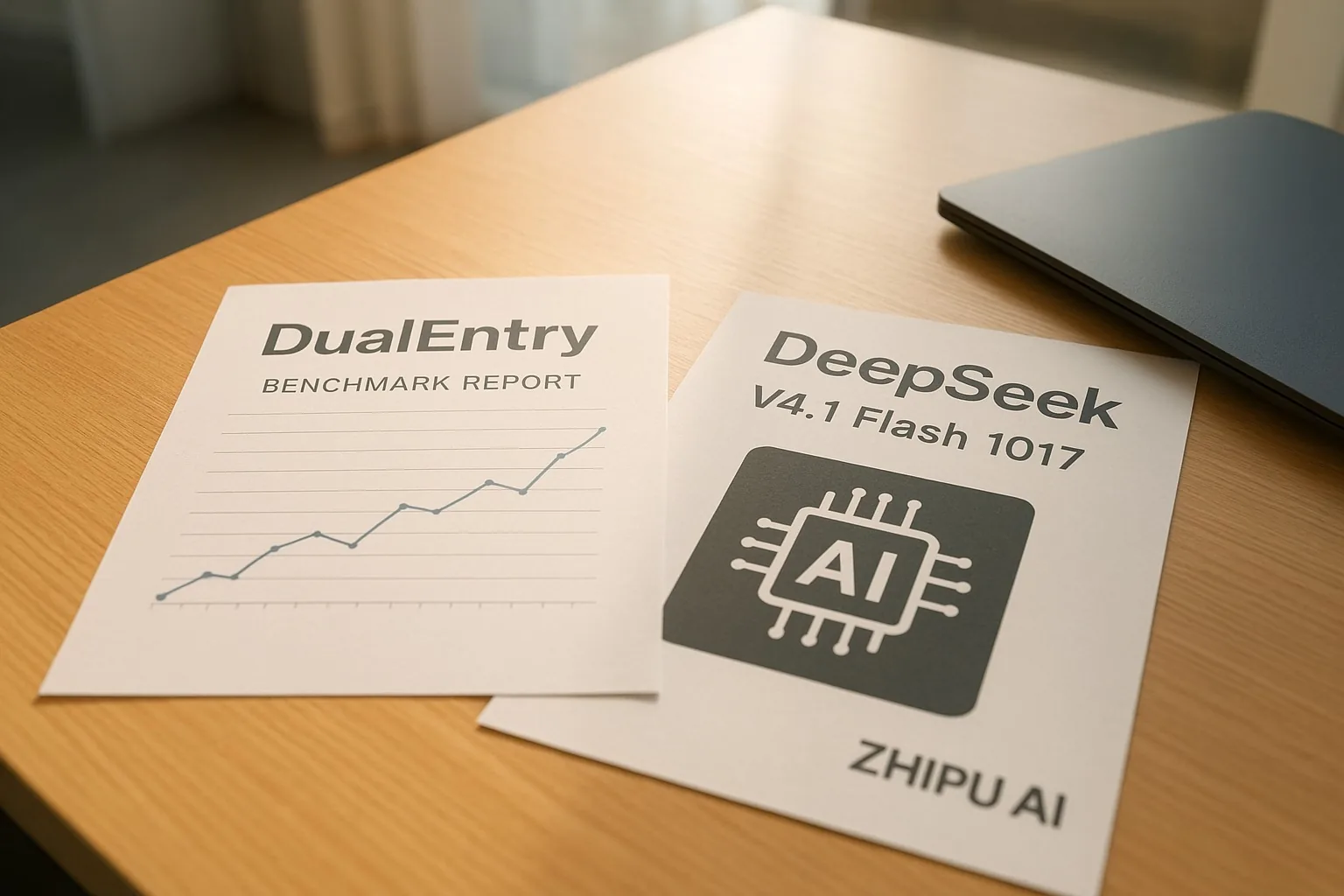
DualEntry's benchmark found DeepSeek V4.1 Flash 1017 scored 82.2% on accounting work, down from 84.2% for the prior V4.1 Flash and tied 10th of 19 models, putting finance buyers on notice about steadiness.
Key Takeaways
- DualEntry reported DeepSeek V4.1 Flash 1017 scored 82.2% on accounting work, down from 84.2% for the earlier V4.1 Flash
- DeepSeek V4.1 Flash 1017 tied for 10th place among 19 tested models in DualEntry’s benchmark
- DualEntry said the newer DeepSeek model ranked alongside Zhipu AI GLM-5.3 and Anthropic Claude Opus 5.5
- DualEntry’s accounting-focused tests measure repeatability in finance tasks and find open models nearing closed models on raw accuracy but trailing on consistency
Benchmark publisher DualEntry released the figures and said the newer DeepSeek model ranked alongside Zhipu AI GLM-5.3 and Anthropic Claude Opus 5.5.
DualEntry runs accounting-focused model tests, which differ from broad chatbot leaderboards because they measure repeated finance tasks and Accounting Work, and the same release said open models are nearing closed models on raw accuracy but still trail on consistency. In accounting, a model that changes its answer across similar inputs creates review work even when its average score looks competitive.
DeepSeek Benchmark Tests Routine Accounting Work
The DeepSeek benchmark is built around repetitive office work and Accounting Work, not showpiece reasoning prompts, which makes a one or two point move more meaningful than it might look on a general benchmark.
Accounting AI is used for classification, reconciliation and exception handling, tasks that depend on repeatability.
A fluent answer is not enough if the same invoice produces a different label for Accounting Work on the next run. The 2 point decline looks small in isolation, but the rank shift is sharper because 19 models sit in a tight band, and when scores cluster a minor slip can move a model several places.
Also Read: Liquid AI Bets On Privacy With 24B On-Device Model, Skips Benchmark Claims
Open Models Still Face A Reliability Gap
This result does not mean DeepSeek worsened everywhere.
It means the newer release underperformed its predecessor on one narrow operational benchmark. That matters because enterprise buyers are changing how they test AI.
Cost and openness still count, yet a finance department also cares about how often the model behaves the same way under repeated inputs and fixed rules.
A chief financial officer may accept slightly lower peak performance if the system is predictable, because predictability is easier to document, easier to monitor and easier to defend in an audit.
From General Chatbots To Domain Benchmarks
Wednesday’s result fits a broader buying shift across enterprise AI as early pilots favored general assistants and procurement is now moving toward domain tests that mirror real departments and approval flows. That shift changes what a benchmark proves.
A broad leaderboard can show language skill, while a narrow benchmark like DualEntry’s tries to show whether a model can survive boring, repeated business use.
The same change also pressures open-model vendors, since hosting control and lower cost help only if the review burden does not climb with them. If staff must double-check too many outputs, the cheaper model becomes costly in labor.
How Consistency Changes AI Buying
A benchmark compresses thousands of model decisions into one score, and its value is not that 82.2% sounds good or bad by itself but that DualEntry measured both DeepSeek versions under one framework.
For DeepSeek, that side-by-side comparison breaks the common assumption that the latest model is automatically the safer enterprise choice, and for finance software vendors it can change which model gets piloted first and which one stays in a limited sandbox.
The next watch point is response from customers and rivals.
If DeepSeek publishes a tuned update or buyers release internal bake-offs, the DeepSeek benchmark could become a procurement reference point beyond accounting.
Read Next: AI Agents Reveal Four Core Concepts That Make Them Work