Google Genie 4 Turns AI Video Into Worlds You Can Steer Live
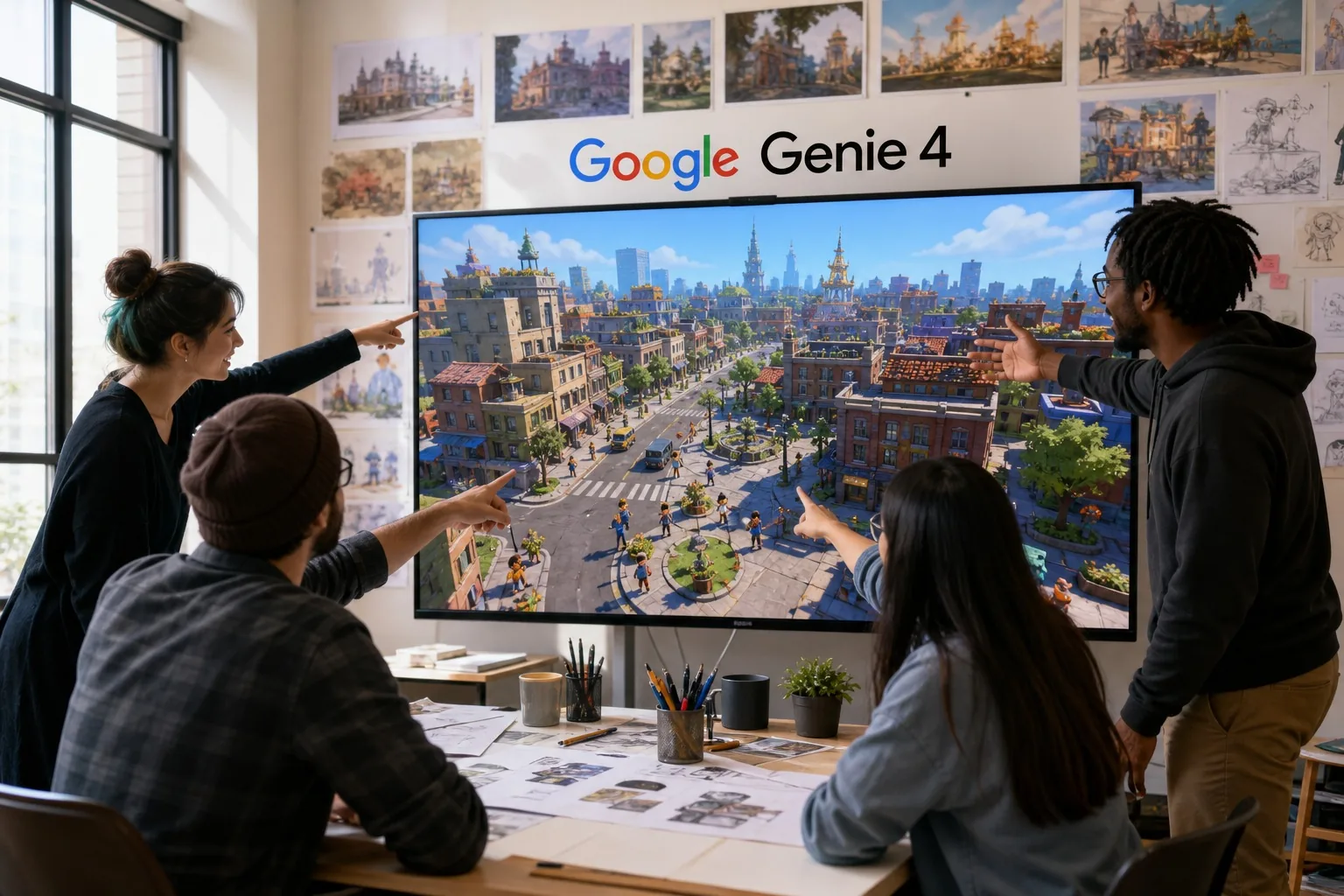
Google showed off Google Genie 4, a new AI tool that turns video scenes into live worlds people can steer in real time for games, robots and training sims.
Key Takeaways
- Google announced Google Genie 4 on Tuesday, saying the world-model AI gives users real-time control over environments, camera motion, actions and sound
- Google framed Genie 4 as an interactive world model from Google DeepMind that predicts how a scene should change over time
- The release did not include pricing or benchmark figures in the cited posts
- Google’s cloud unit highlighted Gemini Robotics Embodied Reasoning 2 and the company indicated organizing around models that act inside environments
Google Genie 4 Moves Past Static Video
Google Genie 4 is framed as Google’s newest interactive world model from Google DeepMind. A world model is an AI system that predicts how a scene should change over time, not just how a single image should look.
That distinction matters because most consumer AI video tools still work like clip generators, returning a finished sequence after a prompt and forcing the user to rerun the model for any major change.
The new system instead treats a scene more like a simulation, where a user can ask for a new action, a camera move or a change in environment dynamics while the world keeps running.
From Research Demo To Product Direction
Tuesday’s release follows a year in which world models moved from research curiosities toward product candidates. Earlier Google work showed AI systems could generate game-like environments, but control was limited and realism broke under longer interactions.
The new model suggests the company now wants a stronger claim on that category.
Google already sells text, image and video models, and world-model capability could become the missing layer for robotics, training simulations and game prototyping.
Also Read: Google Cloud Blocks AI Bots From Getting Full Admin Rights
Google has also spent the past day surfacing other embodied AI work. Its cloud unit on Tuesday highlighted Gemini Robotics Embodied Reasoning 2, another sign the company is organizing around models that act inside environments.
How The Model Could Be Used
The release did not include pricing or benchmark figures in the cited posts.
That leaves open whether this work is headed for broad developer access, a limited preview or an internal path tied to other Google products.
How The System Simulates Change
This belongs to a class of AI systems that model sequences instead of single outputs. In plain terms, Google DeepMind trains the model to predict what should happen next in a scene after a prompt, a camera move or a user action.
That prediction step repeats over and over, so the world keeps updating rather than stopping at one finished answer.
That design matters for developers building interactive software. A standard video generator can make a pretty clip, but a game studio or robotics team needs a system that reacts to new inputs while staying coherent.
If Google can keep objects, sound and motion aligned over time, the approach becomes useful for simulation, not only for content.
The next thing to watch is distribution. If the model appears in developer tools, cloud APIs or robotics products, that would show Google sees world models as infrastructure, not a one-off demo.
If access stays narrow, the work may still be in a proving stage.
Read Next: IBM Puts Locks On AI Bots Before They Move Money Or Change Payroll