Drug Research Startup Bags $215M To Build U.S. Chemistry Labs
Warp Sciences emerged from stealth with $215 million to build U.S. chemistry services using AI and robotics for biotech and pharma research, aiming to automate the wet‑lab bottleneck that slows drug discovery.
Key Takeaways
- Warp Sciences emerged from stealth with $215 million to build U.S. chemistry services for drug research
- The filing and announcements state the $215 million figure is capital raised, not revenue or earnings
- The company said it was founded by veterans from OpenAI, Meta, Terremoto Biosciences, Devoted Health and the White House
- Warp said it will use AI and robotics to support biotech and pharma chemistry work for drug research
The company’s press filing and disclosure, the Business Wire announcement linked in its release, centers on a single hard number. $215 million. That figure is capital raised, not revenue or earnings.
It buys runway to build lab capacity and hire staff to accelerate drug research.
For a valuation implied by that raise to make sense, Warp must translate the cash into repeatable throughput, signed customer contracts or predictable revenue streams that justify investor assumptions about future margins. Separating the expectation of revenue from current reality is essential.
The announcement shows investor conviction but does not state customers, revenue, or booked contracts.
What has to be true for a high valuation. Warp needs to demonstrate it can run chemistry at scale, reduce cycle times measurably, and convert faster wet-lab output into paying programs with midsize biotech or pharma. Without evidence of throughput and contracted demand, the $215 million is a bet on potential, not guaranteed income.
The company said it was founded by veterans from OpenAI, Meta, Terremoto Biosciences, Devoted Health and the White House.
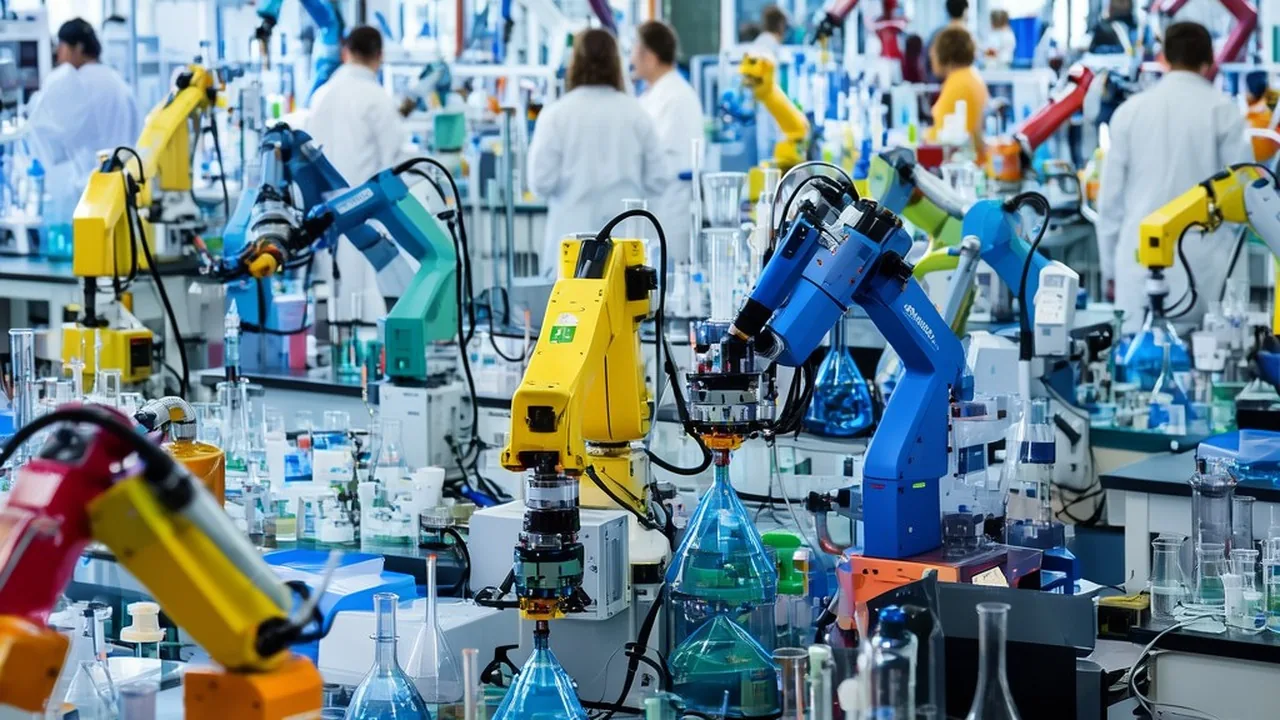
Warp said it will use AI and robotics to support biotech and pharma chemistry work.
That pitch lands on a real bottleneck. AI systems can rank molecules or suggest leads, but drug programs still slow down when compounds must be made, tested and refined in physical labs.
Chemistry is where many software gains get trapped. A better model does not help if synthesis queues stay full.
Warp is trying to sell the missing layer between model output and validated compound data.
In plain terms, that means automating the physical steps after a machine suggests what to test. Robotic lab systems can run repeated reactions, capture results and feed those results back into software loops.
Warp Sciences Bets On The Slowest Part
Warp Sciences is not pitching a general chatbot for science.
It is pitching chemistry services, which usually means molecule design support, synthesis, assay work and iteration across many cycles. That business sits closer to contract research than to pure software.
The size of the round stands out because the company is pre-scale and just left stealth.
A $215 million opening suggests investors think the constraint in AI drug discovery has shifted. The hard part is no longer generating candidates.
It is turning generated candidates into verified chemical data for drug research fast enough to matter.
That view has been building across biotech for months. Several AI drug firms have published model gains, yet the winner still needs instruments, operators and repeatable workflows.
Capital is moving toward the physical stack, not just the inference stack.
Also Read: OpenAI And AI Startup Slash Drug Leads From Hundreds To A Dozen
From Molecule Scores To Drug Research Throughput
Drug discovery systems often start with a target, then search for molecules likely to bind or change it. AI can shrink that search.
It cannot replace the lab stage that proves whether a prediction survives real chemistry. Molecules may be unstable, toxic or impossible to make at scale.
That is why robotics matters here.
A robotic chemistry workflow standardizes repetitive tasks and captures cleaner data from each run. Cleaner data then improves the next training cycle.
The loop only works if software and lab hardware sit close enough to shorten each iteration.
Why Warp Sciences May Matter To Biotech Buyers
The key buyer group is midsize biotech, which often has AI ambition but not internal chemistry capacity. For those teams, Warp Sciences is selling speed without the capital cost of building a full robotics lab.
The bigger shift is strategic. OpenAI alumni and biotech operators are converging around services that turn AI output into experiments, not just dashboards.
If that model works, the market may split in two.
One layer will generate hypotheses. Another will own validation throughput.
Watch whether Warp signs named pharma customers or discloses lab capacity on a per-program basis, because those numbers will show whether this is infrastructure or just expensive positioning.
Read Next: Engineering Startup Bags $34M To Cut Road Project Delays