Alibaba’s Qwen Slashes Image Model To 8 Steps, Skips Quality Benchmarks
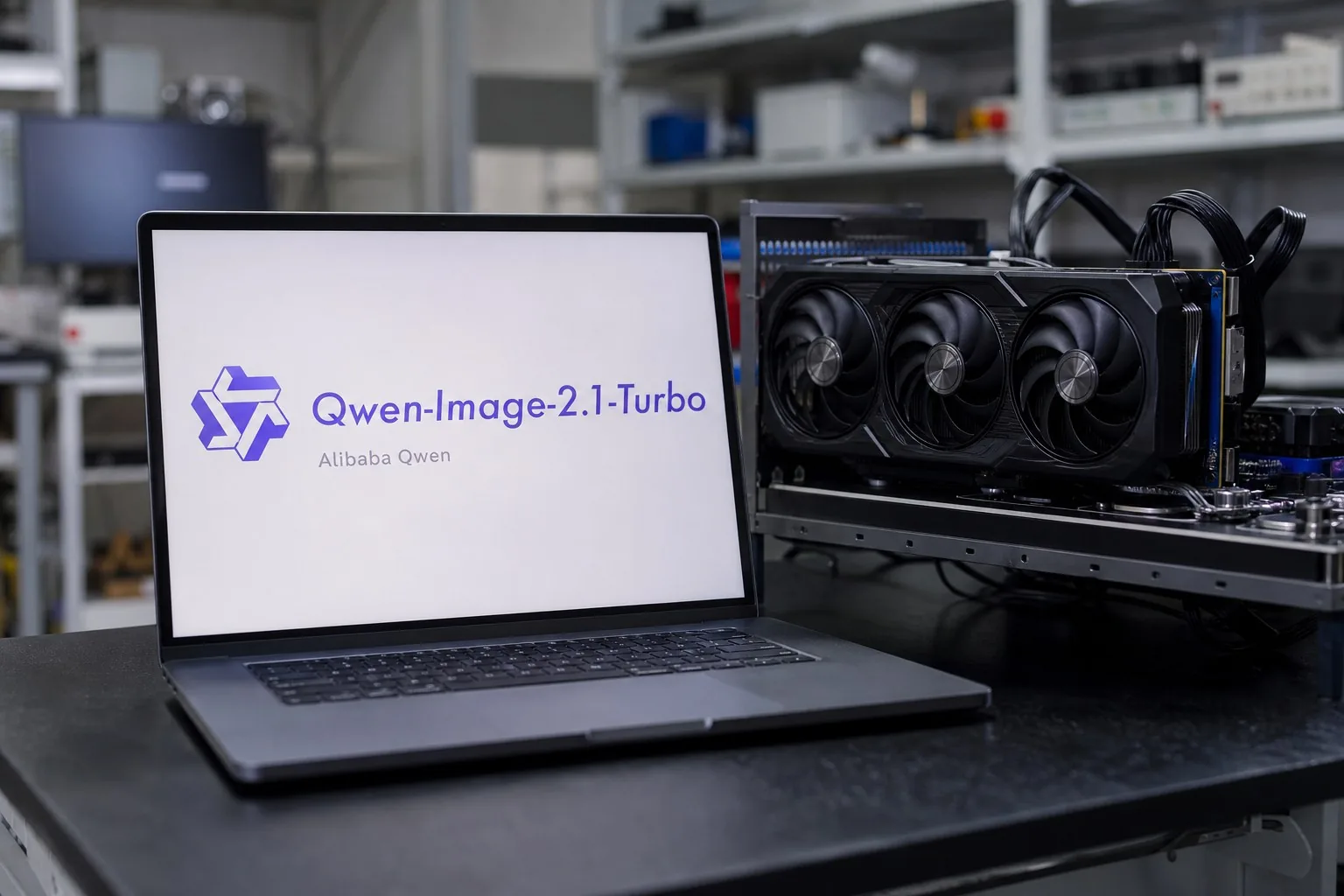
Alibaba‘s Qwen team released Qwen-Image-2.1-Turbo on Friday, making its 7-billion-parameter open-weight image model available to download and run in eight denoising steps.
Key Takeaways
- Qwen-Image-2.1-Turbo uses a 7-billion-parameter open-weight image model available to download and run in eight denoising steps
- Standard diffusion models often need 20 to 50 steps for acceptable image quality
- Open weights allow developers to download, modify and run model parameters on their own hardware rather than use Alibaba’s API
- The release did not provide quality benchmarks against Google’s Imagen or OpenAI’s GPT-Image line
The Qwen team posted the release directly, describing Turbo as using the same 7-billion-parameter base as its predecessor while compressing image generation dramatically. Denoising steps are the iterative passes a diffusion model uses to turn random visual noise into a coherent picture.
Standard diffusion models often need 20 to 50 steps for acceptable image quality.
Eight steps could reduce compute costs and generation latency, but the release demonstrates the checkpoint’s intended speed, not its ordinary-day quality or operating costs, which will depend on deployment.
Open weights let developers download, modify and run the underlying model parameters on their own hardware rather than use an API controlled by Alibaba. That allows startups and researchers to fine-tune or deploy the model without per-request fees, competing with closed systems from labs including OpenAI and Google DeepMind.
The release did not detail hosted availability, pricing, rate limits, regions or tiers.
Alibaba’s Open-Weight Strategy Against Closed Labs
Alibaba has leaned heavily into open-weight releases across its Qwen model family throughout 2026, positioning the approach as a counterweight to closed competitors.
The strategy mirrors Meta‘s early open-source push with Llama, betting that developer adoption and ecosystem lock-in matter more than licensing revenue from the base model. Faster image models have become a competitive flashpoint this year as creative and advertising tools race to cut latency for real-time editing workflows.
Also Read: Google Launches Playground, Turns Text Prompts Into Playable Games: No Code Required
What Eight Steps Means For Builders
Developers building on diffusion image models typically trade step count against image fidelity, since fewer steps traditionally meant blurrier or less coherent output.
Qwen’s claim is that Turbo preserves quality from the full Qwen-Image-2.1 model while slashing the step count, which would lower GPU time per generated image substantially for anyone running the model at scale.
The release thread did not detail actual quality benchmarks against rivals such as Google’s Imagen or OpenAI’s GPT-Image line. Independent testing over the coming weeks will determine whether the step reduction holds up without a quality tradeoff.
Read Next: Anthropic’s Claude Is Now Hunting Flaws In Power Grids And Water Plants After Hitachi Deal