Nvidia’s H100 Defies Aging Curve As Rental Prices Surge On AI Compute Crunch
H100 rental prices are rising on a chip that should be getting cheaper by the month, a sign the AI industry’s compute shortage has not eased heading into the final quarter of 2026.
Key Takeaways
- Cloud providers are charging more for H100 capacity than they were earlier this year
- Nvidia launched the H100 processor in 2022 and has shipped newer architectures including Blackwell and the upcoming Rubin generation
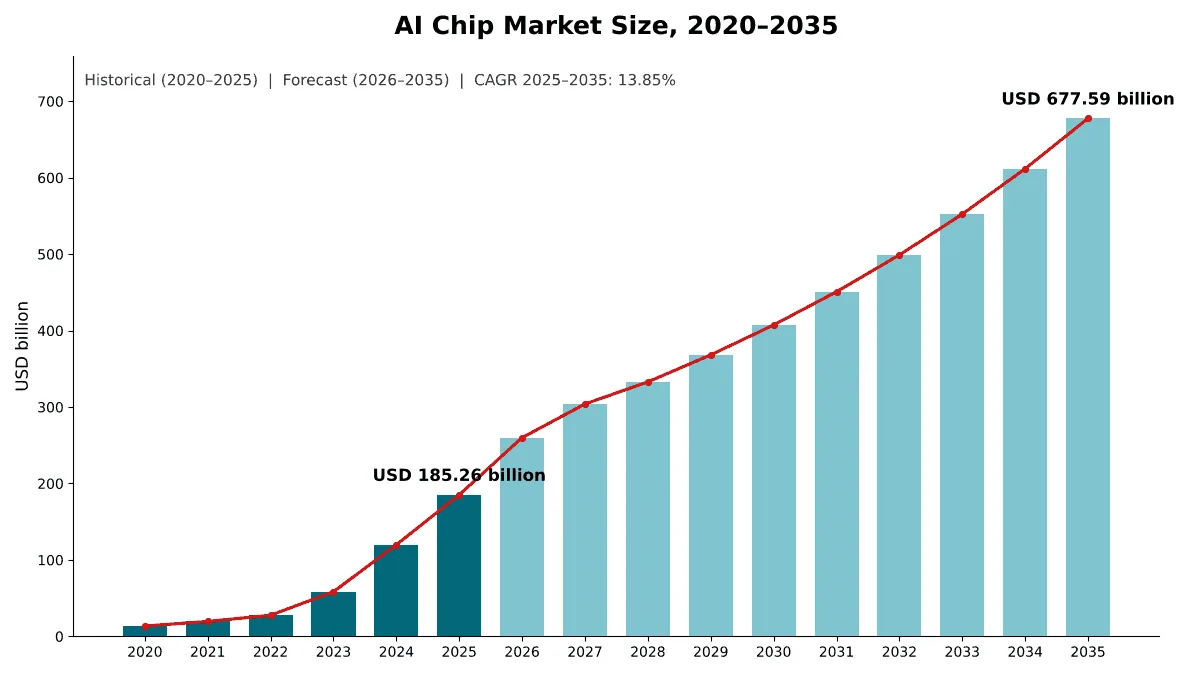
- DC Market Insights projects the global AI chip market to grow from $185.26 billion in 2025 to $677.59 billion by 2035
- H100 rental prices may resume falling once Blackwell and Rubin supply scales through 2027
Nvidia‘s H100 processor launched in 2022 and normally would be sliding down a predictable depreciation curve as newer hardware takes over workloads. Instead, cloud providers are charging more for H100 capacity now than they were earlier this year.
Research firm SemiAnalysis flagged the reversal in a post on X, comparing the GPU market to a wave of demand with no clear end point.
The firm posted that rental prices for the aging chip went up rather than down, even though Nvidia has already shipped multiple newer architectures, including Blackwell and the upcoming Rubin generation.
A separate industry forecast from DC Market Insights put the global AI chip market at $185.26 billion in 2025, projected to climb to $677.59 billion by 2035, underscoring how fast demand for accelerator capacity is expanding across the board.
An H100 is a graphics processing unit originally built for video games that turned out to be extremely efficient at the matrix math behind training and running AI models. Cloud operators buy or lease fleets of them and rent out computing time by the hour, much like renting server space.
Normally, as newer, faster chips like Blackwell ship in volume, demand for older silicon drops and H100 rental prices fall with it, the same pattern seen in used-car or laptop markets.
Also Read: Anthropic’s Latest Haiku Release Cuts Inference Cost 75%
That pattern has broken down.
Demand for any available compute, old or new, has stayed high enough that data center operators can keep raising prices on three-year-old hardware. It points to a capacity crunch broader than any single chip generation, with AI labs and enterprises competing for every available GPU-hour regardless of architecture.
A Shortage That Keeps Finding New Waves
Compute scarcity has been a recurring theme through 2026, with neocloud operators racing to add capacity while hyperscalers lock up multi-year chip supply deals.
Every time one supply constraint eases, whether more Blackwell units shipping or new fabs coming online, demand from agentic AI workloads and inference-heavy applications appears to absorb it immediately. H100 rental prices climbing against that backdrop suggests total compute demand keeps outrunning new supply.
What Would Signal The Shortage Is Breaking
The next test is whether H100 rental prices resume falling once Blackwell and Rubin supply scales through 2027.
Until rental prices for H100 capacity start declining again, the pricing signal suggests AI compute demand is growing faster than the industry can add new silicon.
Read Next: Samsung Locks 80% Of 2027 Chip Supply As AI Memory Demand Soars