Elon Musk Terafab Construction Plan, $119B Breakthrough Megafactory Crushes Records in Texas
Tesla and SpaceX formally confirmed on August 6, 2026, that they will jointly build Terafab, a semiconductor megafactory in Grimes County, Texas, targeting a footprint exceeding 100 million square feet and a total investment of up to $119 billion, making it the largest building ever constructed on Earth.
Elon Musk has framed Terafab not merely as a factory but as the physical foundation for a new era of AI compute, one that his companies argue cannot be satisfied by existing semiconductor infrastructure anywhere in the world. Phase one is already moving, SpaceX is committing $16.8 billion to the initial build, construction is expected to begin this year, and the project is projected to create 3,000 jobs in its first phase alone.
Also Read: Meta Muse Glimmer Crushes Cloud AI With Breakthrough Desktop Model
The elon musk terafab construction plan is, at its core, a bet that the binding constraint on AI progress is not software or talent but raw fabrication capacity, and that no existing supplier is willing or able to close that gap fast enough.
A Scale That Dwarfs Everything Before It, And Why Capacity Is The Point
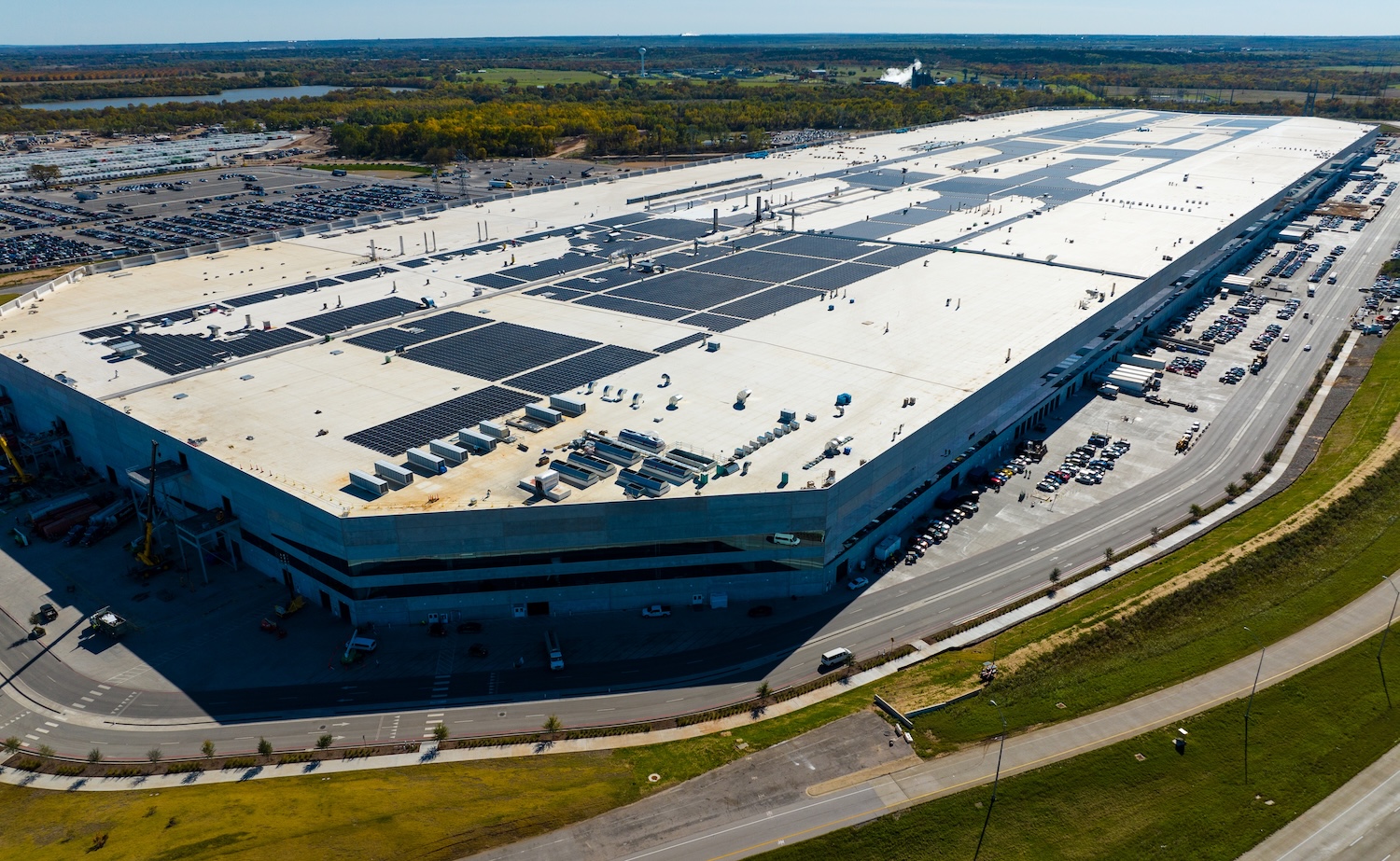
To grasp what 100 million square feet means, the elon musk terafab construction plan envisions a footprint that would exceed the combined area of the Pentagon, Apple Park, the Mall of America, and Giga Texas. Most structures of comparable ambition spend years in planning before a shovel enters the ground.
Drone footage cited by Tom’s Hardware suggests site work is already underway, a signal that the capital commitment is real, not aspirational.
The facility is designed to manufacture AI chips at the 2nm node, a process generation that only a handful of fabs worldwide can currently handle. At the 2nm node, transistor density roughly doubles compared to 5nm, which translates directly into more operations per watt and lower cost per unit of inference, the metric that ultimately determines whether large-scale AI deployment is economically sustainable.
According to reporting from multiple outlets, roughly 80 percent of Terafab’s output is earmarked for orbital data centers, tying the semiconductor build directly to Musk’s broader vision of space-based AI compute. Musk has publicly stated that the elon musk terafab construction plan will not be confined to conventional chip architectures, suggesting the facility will serve as a testbed for entirely new computing paradigms.
That claim is worth watching. New architectures at new process nodes simultaneously is an execution risk that conventional foundries have historically avoided for good reason.
Power is the constraint that rarely appears in the headline numbers but dominates the engineering reality. A facility at this scale, running leading-edge lithography at volume, will require gigawatt-class power infrastructure. Texas’s grid has struggled with demand spikes at a fraction of that load.
How the elon musk terafab construction plan resolves power procurement, whether through dedicated generation, SpaceX’s own energy ambitions, or grid agreements, will determine whether the timeline holds as much as any construction milestone.
The Money, The Partners, And The Political Friction
The $119 billion total figure is the ceiling of a phased plan, with $16.8 billion locked in for phase one. Some reports have linked Intel to the broader financing structure, though the primary confirmed parties remain Tesla and SpaceX acting as co-developers.
The elon musk terafab construction plan has also attracted state support, with Grimes County granting Terafab a tax break, a detail that has already generated local backlash. Residents in the county have begun calling for formal oversight mechanisms over large-scale AI infrastructure projects, according to Business Insider.
The criticism reflects a tension emerging across multiple AI buildout sites in the United States, where the pace of private capital deployment is outrunning local regulatory frameworks. That political friction is unlikely to slow construction timelines materially, but it signals that community consent is becoming a variable that AI infrastructure developers will need to manage alongside permitting and power procurement.
What The Elon Musk Terafab Construction Plan Means For AI Compute Competition
The announcement reframes the competitive landscape for AI chip supply. Nvidia currently dominates AI accelerator production, and TSMC controls the most advanced manufacturing nodes. The elon musk terafab construction plan, if it executes, would give Musk’s ecosystem a vertically integrated path from silicon fabrication to satellite deployment, bypassing third-party chip suppliers for xAI’s own compute needs entirely.
That vertical integration is the strategic core of the project. xAI’s Grok models and any future systems require enormous and sustained compute, and depending on external foundries introduces both cost and geopolitical exposure, particularly relevant given ongoing U.S.-China tensions around advanced semiconductor access. The elon musk terafab construction plan is the answer Musk is building to that dependency. Where the public framing emphasizes scale and national competitiveness, the capital allocation tells a more specific story, this is vertical integration driven by the need to control cost per token at inference, at a volume no contract foundry has committed to delivering.
The timeline is aggressive by any historical standard for semiconductor construction. Phase one alone represents one of the largest single manufacturing investments ever announced in the United States. Whether the execution matches the vision will become clearer as construction milestones emerge later this year, but the capital is committed and the ground is moving.
Read Next: Astra Builds Breakthrough Game Prototypes With Half the Fix Time