Server Maker Stuffs 22,500 AI Sandboxes Into 256-CPU Rack
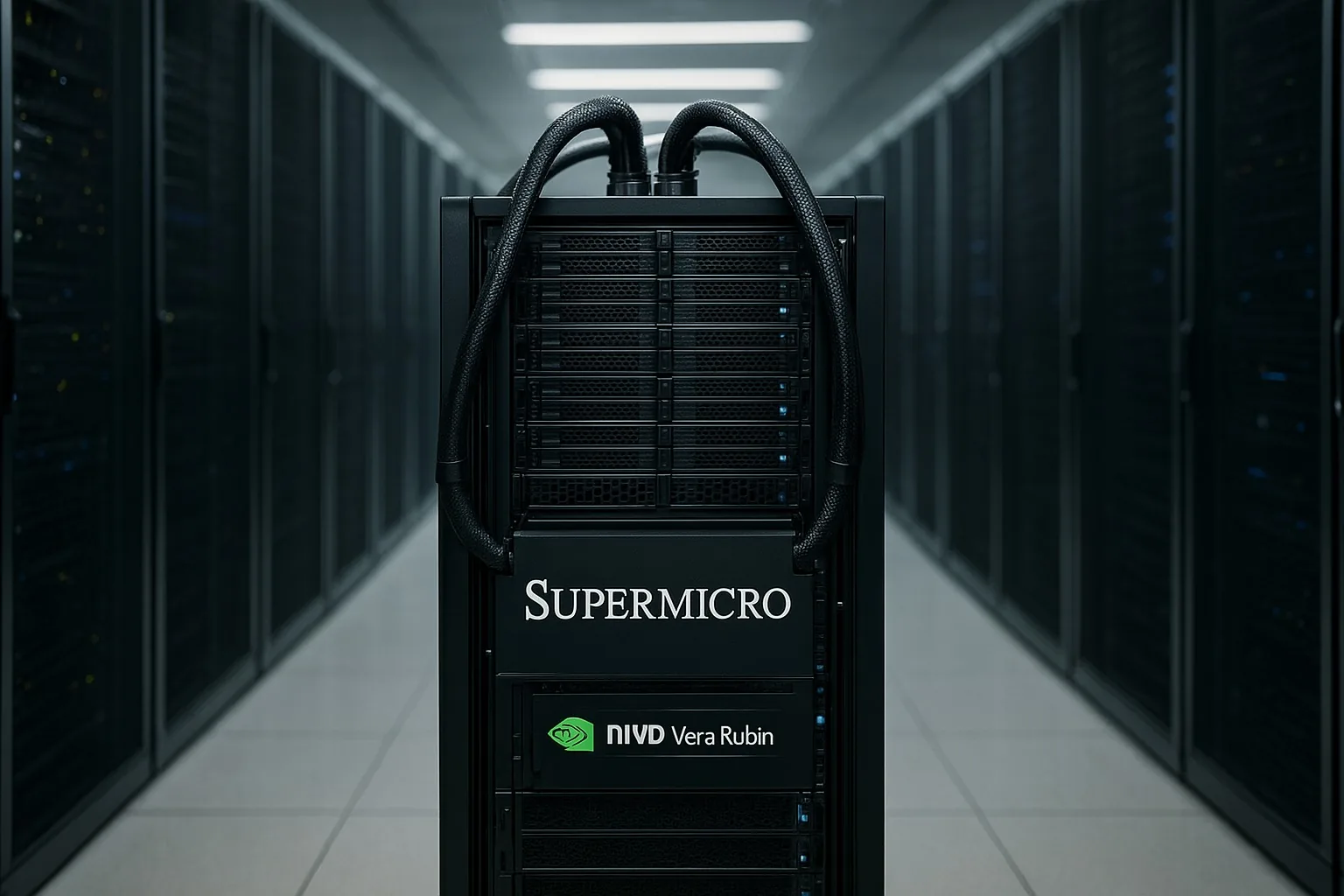
Supermicro unveiled a 256-CPU, 100% liquid-cooled rack that it said can host up to 22,500 isolated sandboxes for Agentic AI, reinforcement learning and data processing and complements Nvidia's Vera Rubin platform.
Key Takeaways
- Supermicro introduced a 256-CPU rack that it said is 100% liquid cooled
- Supermicro said the rack is built to handle 22,500 sandboxes for Agentic AI and related workloads
- Supermicro positioned the rack as a rack-scale design that complements Nvidia’s Vera Rubin platform 22
- The announcement omitted pricing, customer names and power draw figures
Supermicro introduced the system as a rack-scale design that complements Nvidia’s Vera Rubin platform, and it said the unit is fully liquid cooled 22. Supermicro builds servers, racks and full data center systems for AI and enterprise computing.
Vera CPU Rack Packs More Control Logic For Agentic AI 22
The headline number is not the CPU count alone.
It is the mix of dense general-purpose processing and thermal design aimed at the messy parts of AI work that GPUs do not handle well.
Agentic AI systems often need thousands of parallel software environments, test runs and tool calls. Those jobs create orchestration overhead long before a model starts generating text or taking actions.
Sandboxes are isolated software environments that let developers run agents safely without giving one failure access to the rest of the system.
Supermicro said the rack is built to handle 22 22,500 such sandboxes, a figure it uses to illustrate the scale of isolation and control the design targets. That claim ties directly to the company’s positioning of the Vera CPU rack as the scheduling, preprocessing and control layer that Rubin-class GPU systems will need nearby.
From GPU Bottlenecks To Full-Rack Design
The new system extends a clear shift in AI hardware.
Early enterprise builds chased raw GPU count. Newer designs try to balance CPUs, memory, networking and cooling because agentic workloads move data, call tools and juggle many short-lived tasks.
That is a change from last year’s buying wave, when many companies treated AI clusters as GPU piles with enough surrounding hardware to keep them online.
A rack-scale system changes the unit of deployment from single servers to a predesigned block with fixed power, cooling and management assumptions.
For buyers, that can shorten installation planning and reduce the number of one-off decisions inside a data center build. It also gives vendors a way to sell more of the stack, not just the motherboard or chassis.
Also Read: Nvidia Slaps 3 Safety Checks On AI Bots That Handle Company Data
How Liquid Cooling Changes This Rack
Supermicro’s design leans on liquid cooling because dense CPU fleets generate too much heat for older air-first layouts to handle efficiently at scale.
Liquid cooling moves heat through coolant lines rather than blasting more chilled air across hot chips.
Supermicro positions liquid cooling as a way to handle bursts of activity, such as retrieval, browser use and code execution, that Agentic AI deployments can produce, citing the 22,500-sandbox capacity as an operational target for clustered isolation and monitoring. For Nvidia, the complement to Vera Rubin is also practical.
Rubin-class GPU systems will need nearby compute for scheduling, preprocessing and control tasks.
For Supermicro, the Vera CPU rack is a way to sell the support layer around those expensive accelerator clusters rather than competing only on the GPU box itself.
Watch The Power Envelope Next
The release did not include pricing, customer names or power draw figures, and it also did not specify availability dates, supported regions, service tiers or any rate limits for managed offerings.
That absence highlights the gap between a product announcement and the day-to-day reality of deploying Agentic AI at scale. What ships as a validated configuration can still differ from what customers can buy, where they can place it, and how it is billed or integrated into cloud and on-prem tiers.
Specifically, the public statement shows what the validated rack is intended to do but does not establish what actually ships today or when buyers can order and receive units in particular regions or service tiers.
Availability, pricing and operational limits, such as rate limits on managed services or geographic availability, remain unspecified, so customers must treat the announcement as a product demonstration rather than a full commercial offering.
What buyers will watch next is how many racks of this sort ship with full GPU systems rather than as standalone compute islands. If agents keep moving from pilot projects into production software, the spending fight may shift from model training gear to the support hardware that keeps thousands of automated workers contained, scheduled and cooled.
Read Next: Software Firm Ties Itself To 1 Nvidia Ecosystem For Faster AI Rollouts