
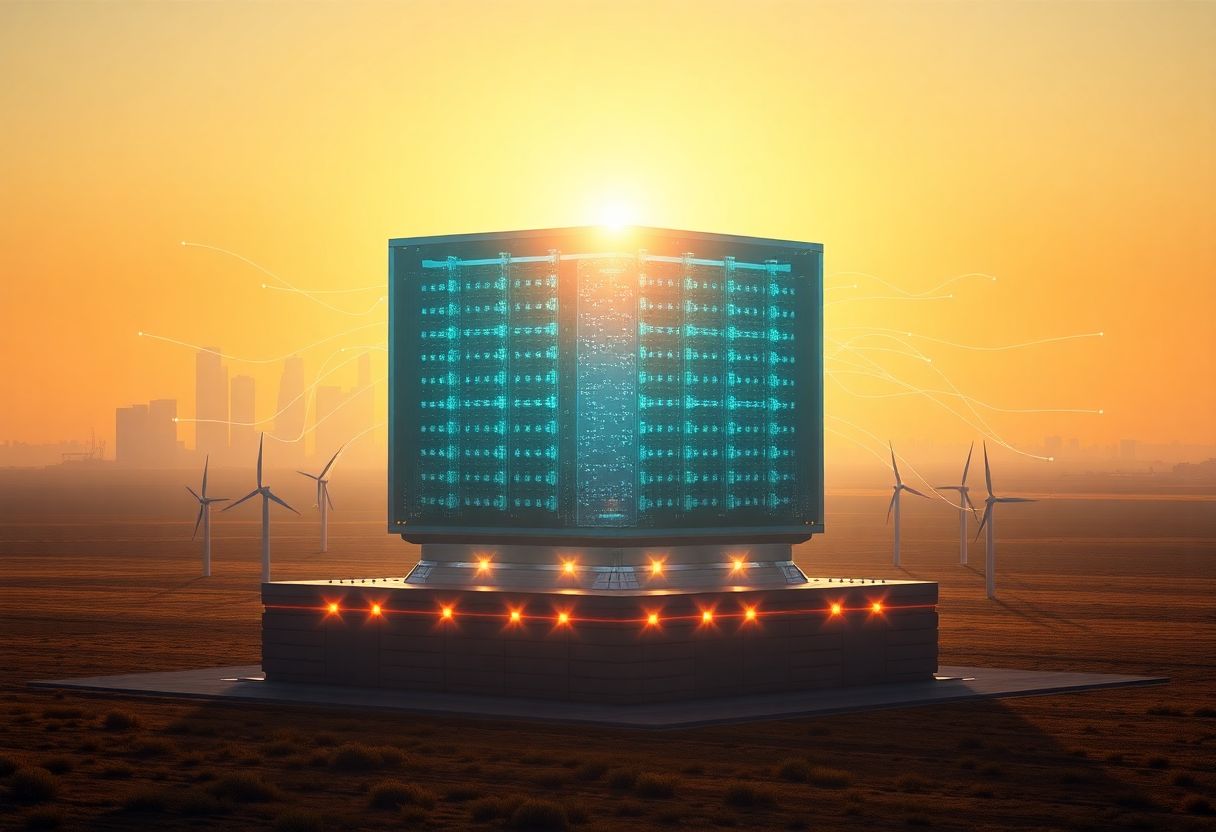
AI Data Center Campus In Texas Poised to Dominate AI Infrastructure
Energy Vault and Crusoe have started building a new AI compute data center campus in Snyder, Texas, with the first phase set to deliver 8 megawatts of power for AI computing.
The site is designed to grow to 25 megawatts and begin commercial operations in the first quarter of 2027, giving AI companies a faster way to access compute capacity by placing modular data centers close to cheap West Texas power.
The project represents a new model for AI infrastructure buildout, pairing an energy storage company with a compute-focused cloud provider to move faster than traditional hyperscale construction timelines allow.
The official announcement from Business Wire describes the facility as a demonstration of Energy Vault’s “energy-forward” approach to AI compute deployment. Snyder sits in West Texas, a region with significant wind generation capacity, making it attractive for power-intensive workloads.
Why The Campus Became An AI Infrastructure Hub
The location is not accidental.
West Texas carries some of the lowest wholesale electricity prices in the continental United States, driven by abundant wind generation that frequently outpaces local demand. AI training and inference workloads are voracious consumers of electricity, so proximity to cheap, reliable power is a genuine competitive moat, not a secondary consideration.
Energy Vault built its reputation around gravity-based energy storage, a technology that lifts heavy masses when power is cheap and drops them to generate electricity when prices spike.
That capability matters directly to an AI data center operator. Compute clusters run best under stable, continuous power.
A storage buffer smooths out the intermittent nature of wind, allowing the campus to draw from the grid opportunistically and discharge stored energy during peak demand or curtailment events.
Crusoe, for its part, has spent several years deploying compute at the edge of the energy grid, originally to capture flared natural gas at oil fields. The Campus in Snyder Texas is a more formal expression of that same instinct: find stranded or underpriced power, build compute on top of it.
What Crusoe Spark Modular AI Data Centers Actually Are
The Crusoe Spark product is a pre-engineered, factory-built data center unit that can be shipped to a site and commissioned far faster than a purpose-built facility.
Where a conventional hyperscale campus can take two to four years from land acquisition to first power-on, modular deployments can compress that timeline to months.
Each Spark unit arrives with integrated power management, cooling, and networking. The operator connects it to a power source and begins deploying compute hardware.
Also Read: Kimi K3 Open Weights Go Live — 2.8T Parameters, Free to Anyone Who Can Run Them
The 8-megawatt initial phase at the Campus in Snyder Texas represents roughly the output of a small peaking power plant, enough to support thousands of GPU servers running AI inference or training jobs at any given moment.
Also Read: AI Agent Payments Breakthrough: x402 Protocol Launches Faster Transactions
The expandability to 25 megawatts follows a modular logic: the site infrastructure, land, power connection, and cooling water rights are established upfront, and additional Spark units are added as customer demand grows. This avoids the capital risk of building a large facility before revenue exists to justify it.
From Energy Storage To AI Infrastructure Campus
Energy Vault’s pivot into AI compute hosting is the latest chapter in a broader pattern across the energy sector.
Grid-scale storage companies, previously focused on utility contracts and capacity markets, have recognized that AI data centers are willing to pay a premium for guaranteed, stable power.
The company’s storage technology creates a natural on-ramp. A campus that can absorb grid power opportunistically and dispatch it steadily is precisely what a GPU cluster operator needs.
The groundbreaking formalizes a partnership between a firm with energy infrastructure expertise and one with compute deployment experience, combining two complementary capabilities under one roof.
The timing fits a pattern across the American Southwest and Texas in particular. Several large technology companies have announced Texas data center investments in this year alone, drawn by deregulated electricity markets, lower land costs, and a business-friendly regulatory environment compared to coastal states.
Snyder is a smaller, more rural location than the Dallas or Austin metro areas that typically attract hyperscale attention, but that is arguably the point. Land and power in secondary markets are cheaper, and modular construction makes the build economically viable at smaller scale.
What Q1 2027 Means For The AI Compute Market
The commercial operation target of Q1 2027 puts the Campus in Snyder Texas online during what most compute analysts expect to be a period of peak GPU scarcity.
Demand from frontier AI labs, enterprise fine-tuning customers, and inference-at-scale providers has outpaced supply of both chips and powered rack space for most of this year.
A 25-megawatt campus is not a hyperscale facility. Google’s recently expanded Hyperion complex in Louisiana is targeting five gigawatts, two hundred times larger.
But the modular approach addresses a different segment of the market. Mid-sized AI companies, regional cloud providers, and enterprise customers running dedicated inference clusters often need tens or low hundreds of megawatts, not gigawatts, and they need it faster than a four-year construction cycle allows.
If the project hits its Q1 2027 date, Energy Vault and Crusoe will have demonstrated a repeatable playbook: identify a site with access to cheap, renewable-adjacent power, ship modular compute infrastructure, and be generating revenue within roughly six months of breaking ground.
That timeline, if proven out, has implications well beyond West Texas.
Read Next: Bitmine Buys 10,000 More ETH, Pushing Its Treasury to 5.79 Million Tokens