Oracle Hands Google AI Chips To Cloud Buyers Eyeing Nvidia
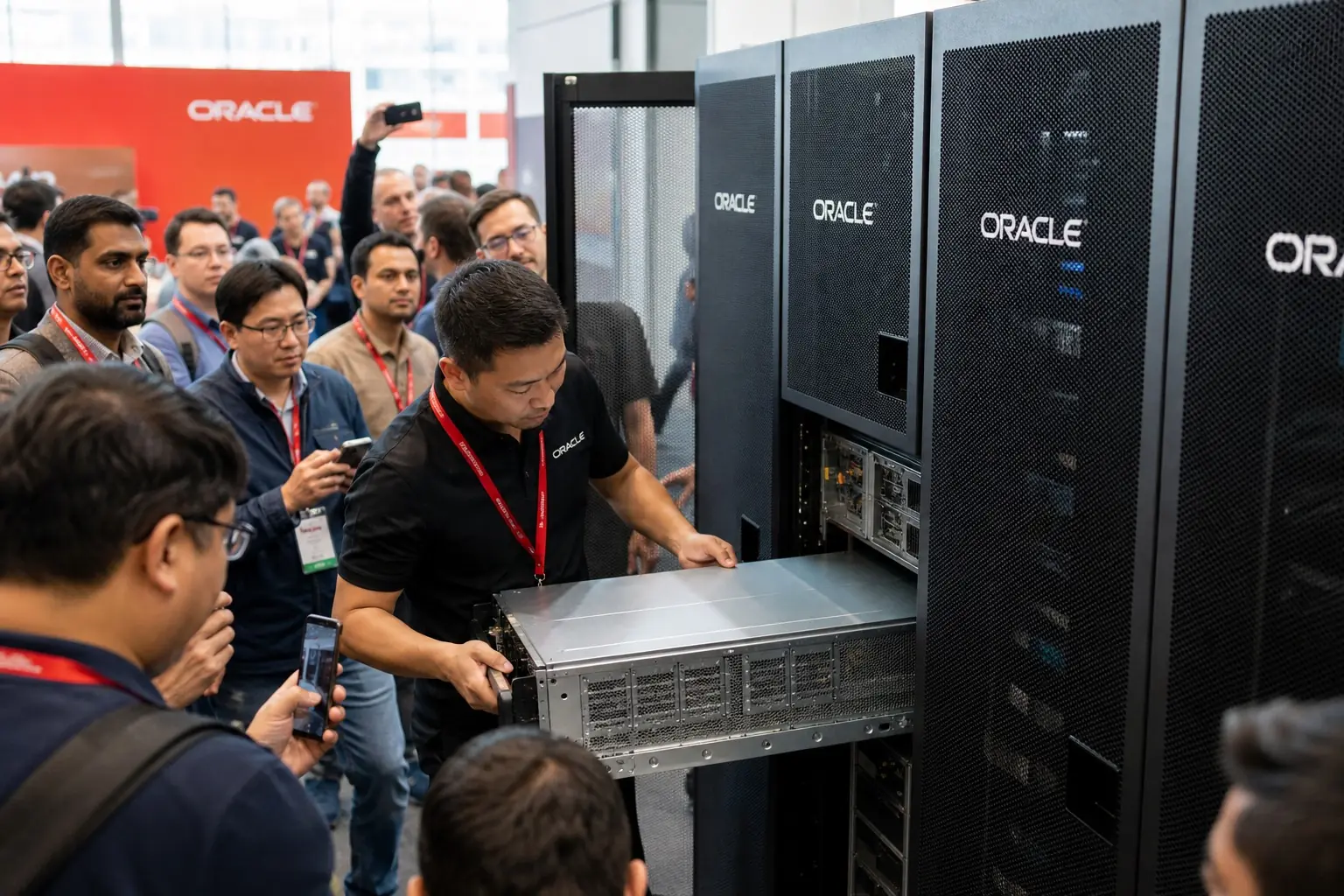
Oracle, the business software and cloud company, will add Google TPUs to its cloud so big companies can build AI without relying only on Nvidia chips.
Key Takeaways
- Oracle will offer Google’s tensor processing units inside Oracle Cloud Infrastructure
- The move gives enterprise buyers another way to train and run AI systems without relying only on Nvidia-based fleets
- Oracle announced the TPU move during its AI World event, where it also rolled out broader AI products tied to OpenAI and Snowflake
- Oracle still needs to show which Google TPUs arrive first, in which regions, on what pricing and with which software support
Oracle announced the move during its AI World event, where it also rolled out a broader set of AI products tied to OpenAI, Snowflake and new security tools. The Register reported further details on how Oracle plans to position the offering for customers waiting for clearer returns on AI spending.
The immediate point is choice.
Most enterprise AI demand has piled into Nvidia systems because they are widely supported by model frameworks and cloud tooling. Google TPUs offer a different accelerator design, built for machine learning workloads, and Oracle is betting that some customers want that option inside OCI rather than only inside Google Cloud.
Oracle Cloud Infrastructure is Oracle’s public cloud platform for compute, storage, databases and AI services.
OCI has spent the past year trying to win buyers that want high-performance AI clusters but do not want all of their data or applications tied to one cloud vendor.
Google TPUs Give Oracle A New Sales Angle
For Oracle, the pitch is less about beating Google on silicon and more about absorbing more AI demand onto OCI. If a customer prefers Google TPUs for model training but wants Oracle databases, enterprise software or regional cloud capacity, Oracle can now try to keep that workload in-house.
That could matter for corporations building mixed stacks.
A bank may want one model optimized for Google TPUs, another tuned for Nvidia GPUs and customer data stored close to existing Oracle systems. Before, that often meant crossing clouds and accepting more operational friction.
Google has long treated TPUs as a differentiator for its own cloud.
Putting Google TPUs into OCI suggests the competitive boundary is shifting from exclusive hardware access toward broader distribution, as long as the commercial terms still work for both sides.
Also Read: SpaceX Plows $40B Into Nvidia Chips For AI Cloud
Oracle’s AI Week Keeps Getting Broader
Tuesday’s disclosure follows a burst of Oracle AI product news across infrastructure, applications and security. Earlier disclosures focused on Oracle’s use of Nvidia racks and deeper links with OpenAI.
The TPU step broadens that message from software integration toward hardware optionality.
That matters because cloud AI buyers now ask two separate questions. First, can a provider get enough chips.
Second, can it offer more than one hardware path when costs, latency or model compatibility change. Oracle is trying to answer yes to both.
The strategy also speaks to a larger market shift.
Clouds no longer win AI deals only by owning the most chips. They also need to connect those chips to customer data, compliance controls and existing software budgets.
Also Read: Nvidia Turns To Synopsys To Catch Costly Chip Errors Before Build
What Buyers Should Watch Next
The next test is execution.
Oracle still needs to show which Google TPUs arrive first, in which regions, on what pricing and with which software support.
Those details decide whether Google TPUs on OCI become a niche option or a real second lane for enterprise AI. If Oracle can make migration and orchestration simple, it strengthens its hand in a market still dominated by a few chip and cloud suppliers.
How Google TPUs Fit Into OCI
Google TPUs are custom chips built for tensor operations, the matrix math that powers model training and inference.
Nvidia GPUs began as graphics processors and later became the default AI workhorse because developers could program them flexibly. TPUs started from the opposite direction. Google built them to run machine learning efficiently at scale inside its own infrastructure.
For Oracle customers, the practical change is not the chip brand alone.
It is the ability to keep applications, databases and governance inside OCI while selecting a different accelerator under the hood. A retailer using Oracle databases could train a recommendation model on Google TPUs, then deploy it close to its transaction systems without shifting the whole workload into Google Cloud.
That matters most for enterprises with old software estates.
Many large companies already depend on Oracle for finance, HR or databases. If Oracle can present Google TPUs as another OCI resource, those firms get more flexibility without rewriting every surrounding system.
Read Next: Crypto Firm ONDO Floods Robinhood Chain With 15 Stock And Fund Tokens