Can AMD’s 3.2-Trillion-Transistor Helios Rack Break Nvidia’s Grip?
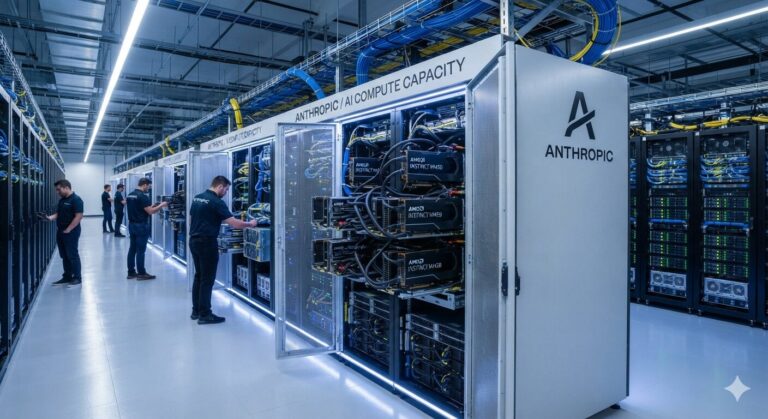
AMD has started shipping Helios, its AI rack system, and the GPUs inside it are built with 3,200 billion transistors.
That puts the company in a position it hasn’t held before — a full-stack AI infrastructure contender.
The announcement came at AMD’s Advancing AI 2026 event in San Francisco.
UBS moved fast on it. Within a day of the event, the bank raised its AMD price target.
And the reasoning wasn’t just about GPU specs. UBS pointed to AMD’s higher-margin server CPU business — a part of the story Wall Street has largely overlooked.
AMD Helios Rack Takes Aim At Nvidia’s Full-Stack Dominance
The AMD Helios rack is AMD’s bid to sell not individual chips but an entire integrated AI server system. (AMD) shares drew fresh analyst attention after the announcement, reflecting how much the market has shifted toward rack-scale thinking. That distinction matters enormously in today’s data center market.
Hyperscalers and cloud providers increasingly prefer to buy rack-scale solutions rather than assembling individual components. Nvidia’s NVL72 and GB200 rack products have dominated that category, and the new system is a direct response.
The GPUs inside the AMD Helios rack are built on AMD’s latest process node and pack 3,200 billion transistors per chip, a figure that reflects how far semiconductor density has advanced. A transistor is the fundamental on-off switch inside every chip.
More transistors per chip generally mean more compute cores, larger on-chip memory, and faster matrix math, which is the core operation behind AI model training and inference. Inference is the process of running a trained AI model to generate an output, the step that happens every time a user queries ChatGPT or a similar service.
AMD’s move into full-stack rack sales mirrors the strategy Nvidia has used to lock in customers.
When a data center buys a complete rack system, including the interconnect fabric, the cooling, and the software stack, switching costs rise sharply. AMD is attempting to build those same switching costs rather than competing purely on chip-level benchmarks.
From Chip Vendor To Full-Stack Contender
AMD’s path to this integrated rack platform is grounded in a series of acquisitions and product cycles stretching back several years.
The company acquired Xilinx in 2022 for $49 billion, adding programmable logic chips that complement GPU workloads. It has also expanded its ROCm software platform, which is the AMD equivalent of Nvidia’s CUDA programming environment.
CUDA is the software layer that lets developers write AI training code once and run it efficiently on Nvidia hardware. ROCm has historically lagged CUDA in ecosystem maturity, and that software gap has been AMD’s most persistent competitive liability.
The Helios announcement signals AMD believes its software stack is now competitive enough to support rack-scale sales.
A data center cannot buy a full AMD rack and then rely on Nvidia’s software. AMD must deliver the full package, hardware and software, which makes the system a credibility test as much as a product launch.
Also Read: Anthropic Ends Fable Data Retention Flaw in 5.1 Release
UBS’s decision to raise its price target immediately after Advancing AI 2026 reflects a specific thesis.
The bank said its attention was drawn to AMD’s server CPU business, which carries higher gross margins than GPUs. AMD’s EPYC processors have taken significant market share from Intel in cloud data centers.
If AMD can cross-sell EPYC CPUs alongside its Helios rack systems, the bundled economics become more attractive for buyers and more profitable for AMD than GPU sales alone.
Why The AI Compute Market Needs A Credible Nvidia Alternative
Nvidia’s share of the AI GPU market has held above 80% through the current infrastructure buildout. That concentration gives hyperscalers little pricing leverage and creates supply chain risk when Nvidia cannot fulfill orders fast enough.
Google, Microsoft, Amazon, and Meta have all invested in custom AI chips partly to reduce that dependence. AMD offers a third-party alternative that runs standard software, unlike custom silicon that requires bespoke tooling.
The announcement that the AMD Helios rack is shipping, not just sampling, is the significant detail.
GPU companies routinely announce products many months before they reach customers. Shipping status means data centers can now place and fulfill orders, which matters for capital expenditure planning cycles that run on quarterly schedules.
Google separately disclosed this week that it raised its 2026 capital spending plan to between $195 billion and $205 billion, most of it directed at AI compute infrastructure.
That scale of spending is large enough that even a modest shift of GPU purchases toward AMD changes the competitive landscape materially.
What UBS Sees That The GPU Headlines Miss
The bank’s price target revision focused on a detail that most coverage of Advancing AI 2026 skipped. AMD’s server CPU business generates gross margins that are structurally higher than GPU margins, because CPUs face less commoditization pressure in the near term and because EPYC has pricing power in cloud.
When AMD sells a Helios rack, it typically pairs it with EPYC host processors. That pairing means each rack sale carries CPU margin attached.
Analysts who model AMD purely on GPU share versus Nvidia miss this bundled revenue stream.
If the AMD Helios rack gains traction in even a fraction of the new data center capacity coming online through 2027, the CPU attachment rate could become a meaningful earnings driver independent of how AMD performs against Nvidia’s GPU benchmarks.
AMD’s challenge remains its software ecosystem. ROCm’s compatibility with popular AI frameworks like PyTorch has improved, but many enterprise teams have years of CUDA-optimized code and resist porting it.
AMD’s ability to close that gap through tooling, migration support, and third-party software partnerships will determine whether the platform converts interest into durable market share.