Samsung Says AI Memory Shortage Runs Through 2027, Relief May Wait Until 2028
Samsung confirmed on July 31 that the AI memory shortage squeezing the chip industry is going to get worse through 2027 — and probably won’t ease until 2028.
The South Korean conglomerate delivered that forecast in earnings commentary published alongside its second-quarter results. Its warning was blunt: demand from AI data centers has run well ahead of the industry’s capacity to expand production.
Amazon put a number on the same problem that day. Its annual capital expenditure is heading toward $220 billion, driven in large part by the cost of AI memory.
The gap between what hyperscalers need and what chipmakers can deliver isn’t closing.
It’s widening.
AI Memory Shortage Is Rewriting The Economics Of Every Device
AI memory shortage is not a single product problem.
It runs through the entire semiconductor supply chain, from server racks to smartphones.
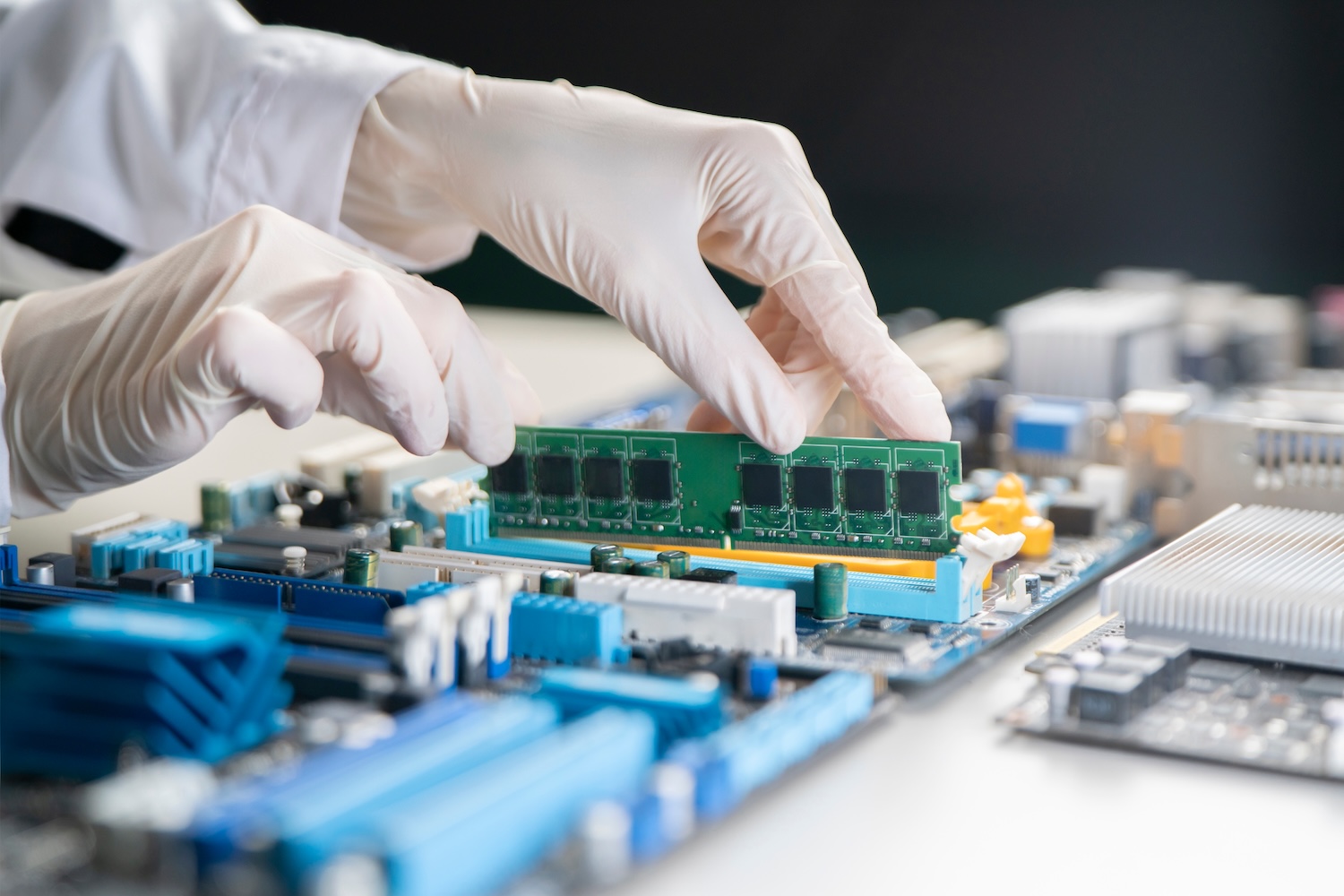
The memory type at the center of the crisis is high-bandwidth memory, or HBM. HBM stacks multiple DRAM chips vertically on top of one another, connected by thousands of microscopic wires called through-silicon vias.
This vertical architecture lets processors like Nvidia’s H100 and B200 GPUs move data at speeds that conventional memory cannot match. A single Nvidia B200 GPU requires roughly 192 gigabytes of HBM3e, the latest generation.
An AI training cluster holding thousands of such GPUs needs a staggering volume of the component.
Manufacturing HBM is slow and capital-intensive. Samsung, SK Hynix, and Micron are the only companies that produce it at scale, and each new generation requires extensive retooling.
SK Hynix delivered the first HBM3e chips to Nvidia in early 2024 and has held a production lead since. Samsung has faced yield challenges on its own HBM3e line, meaning a meaningful fraction of its wafers fail quality checks and cannot ship.
That bottleneck, combined with relentless demand growth from AI data centers, is the core mechanic behind the AI memory shortage Samsung described on July 31.
How A Server-Rack Problem Became A Consumer-Device Tax
The AI memory shortage does not stay inside data centers. DRAM is a shared resource.
When hyperscalers and cloud providers absorb a disproportionate share of global DRAM wafer starts to feed AI workloads, the supply available for conventional products, including laptops, smartphones, and gaming consoles, contracts. Manufacturers of those devices face higher component prices, and some portion of that cost passes through to retail buyers.
Samsung’s forecast of a shortage extending to 2028 suggests this dynamic will remain in place for at least two more product cycles.
For a consumer buying a laptop or a mid-range phone in 2026 or 2027, the AI build-out is not an abstract data center story. It is part of the reason that device costs are not falling as quickly as they historically have during periods of chip oversupply.
The Hyperscaler Demand Machine Shows No Sign Of Stopping
Amazon’s acknowledgment that its annual capital expenditure would hit $220 billion, partly attributed to AI memory costs, gives Samsung’s warning a concrete anchor.
Tom’s Hardware reported on July 31 that Amazon, Google, Meta, and Microsoft have collectively spent more than $1 trillion on AI infrastructure, with an additional $745 billion expected to be added in 2026 alone. That pace of spending implies the AI memory shortage will persist even if model efficiency improves.
Efficiency gains do apply some brake.
Newer AI architectures use memory more cleverly, and quantization techniques let models run on less memory by reducing numerical precision. But researchers have historically used efficiency improvements to run larger models rather than to reduce hardware requirements.
The net effect on memory demand has been upward, not downward.
A Warning Samsung Has Specific Incentives To Make
Samsung’s position here carries an important nuance. As one of the three companies that can supply HBM at scale, Samsung has an interest in managing expectations downward.
A shortage narrative supports higher prices and justifies the capital expenditure Samsung itself must make to retool production lines for next-generation HBM. That does not make the forecast wrong, but it is context worth holding alongside the data.
Also Read: Who Is Actually Paying for the AI Data Center Boom?
The Answer Stays Murky
From Niche Server Component To The Market’s Defining Constraint
Before AI training workloads scaled to their current size, HBM was a specialist product used mainly in high-performance computing and graphics. The memory market was broadly cyclical: periods of oversupply and price collapse followed periods of shortage and margin expansion.
Samsung, SK Hynix, and Micron managed their capacity investments with that cycle in mind.
The arrival of transformer-based large language models changed the calculus. Each successive generation of frontier AI model, from GPT-3 through to the models shipping in 2026, has consumed more memory bandwidth than its predecessor.
The TechCrunch report on Samsung’s earnings comments on July 31 notes that the AI memory shortage is pushing up both component costs and retail device prices across categories, a sign that the AI memory shortage has become structural rather than cyclical.
What Breaks The Shortage, And When
Three things could shorten the timeline Samsung described. First, a major AI model efficiency breakthrough could reduce per-inference memory requirements enough to ease demand.
Second, a new entrant could reach HBM production at meaningful scale, though no credible candidate is close to that threshold. Third, a slowdown in hyperscaler capital expenditure, driven by a recession or a reassessment of AI returns, could cool demand faster than the current trajectory suggests.
None of these look likely before 2027.
Samsung’s own guidance implies the company is not planning for a recovery before 2028. For AI infrastructure investors, memory suppliers, and device manufacturers, a multi-year AI memory shortage is the operating assumption.
Read Next: OpenAI Publishes EU AI Act Framework Hours After Brussels Gained Global Ban Power