Amazon Adds Nvidia Chip Sharing To Cut AI Serving Costs
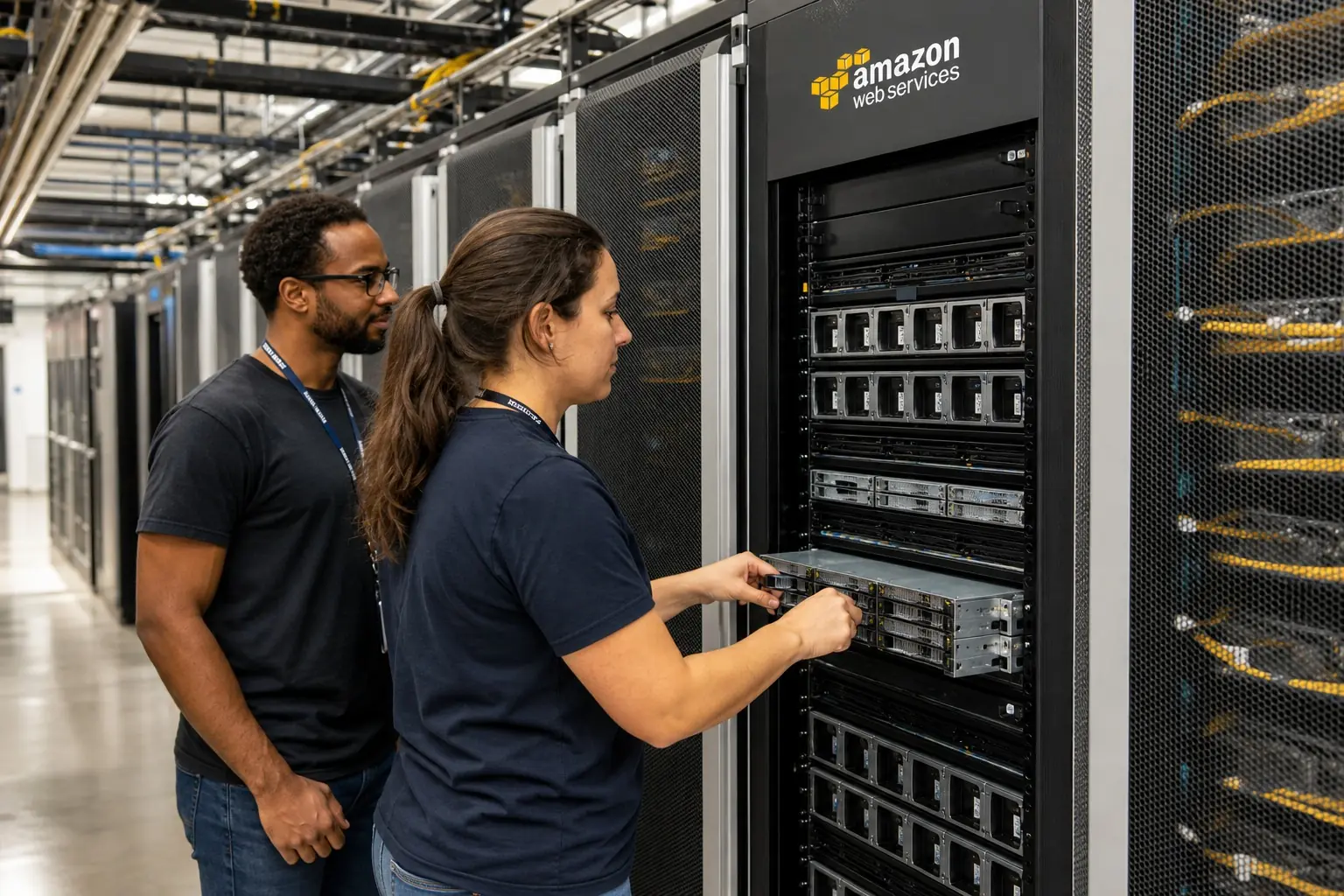
Amazon Web Services added Nvidia‘s chip-sharing system to SageMaker so several models on an endpoint can run on one graphics chip at once, which can lower the cost per request.
Key Takeaways
- SageMaker Inference now supports Nvidia Multi-Instance GPU (MIG) partitions so different models on an endpoint can share one accelerator
- AWS added two optional API fields to let customers place an endpoint on either a full GPU or a specific MIG slice
- MIG partitions give each slice its own memory and compute allocation for isolated hardware-level resources
- Packing mixed workloads onto one accelerator can raise utilization and lower the cost per request for inference fleets
AWS said in a Friday blog post that SageMaker Inference now supports Multi-Instance GPU for model endpoints. Nvidia describes MIG as hardware partitioning that turns one physical GPU into several isolated instances.
Amazon Web Services runs cloud infrastructure and machine learning products, and SageMaker Inference is its managed system for serving models through production endpoints.
The new support targets a basic economics problem in AI serving, small and medium models often do not use a full modern GPU.
One GPU, More Paying Work
A dedicated endpoint gives a model predictable performance, but it can also strand expensive compute. If a model only needs a fraction of a GPU, the unused portion still gets reserved and billed.
MIG changes that by slicing the chip at the hardware level. Each slice gets its own memory and compute allocation, which means a small model can share a GPU with another model without software-only sharing tricks.
That matters most for inference fleets with mixed workloads. A company may serve a chatbot, a classifier and an embedding model at once, all with different traffic patterns.
Packing them onto one accelerator can raise utilization and lower the cost per request.
From Training Race To Serving Margin
The AI market spent two years talking about buying more GPUs. The next fight is getting more revenue from the GPUs already in racks.
Inference, not training, is where many cloud bills settle into recurring operating cost.
Also Read: Amazon Says New Memory Trick Could Cut Chatbot Costs
Friday’s update follows a broader shift across the cloud stack. Instead of assuming one large model per accelerator, providers are tuning around fragmentation, isolation and scheduling.
Those are less flashy problems, but they decide whether AI products can hold margin at scale.
AWS did not tie the feature to one model family. That gives it wide relevance for teams deploying image models, smaller language models or task-specific systems that do not justify exclusive access to a top-end chip.
How SageMaker Uses Nvidia Multi-Instance GPU
SageMaker Inference manages the servers that answer model requests after training ends. A model endpoint is the live service that receives prompts or data and returns predictions. With MIG enabled, AWS can place an inference component on a defined fraction of a compatible Nvidia GPU instead of the whole device.
The key change is isolation at the hardware layer.
A software scheduler can time-share a GPU, but one noisy workload can still interfere with another. MIG splits resources before jobs run, so each slice has reserved capacity and memory.
That makes latency and failure domains easier to reason about.
For startups and internal platform teams, the gain is not just lower cost. MIG also makes it easier to match hardware to workload size.
A lightweight moderation model no longer needs to ride alone on the same class of accelerator used for far larger systems.
Operational Complexity And Placement Decisions
GPU partitioning can cut waste, but it also adds placement choices. Teams now need to decide when to use a full GPU, when to use a slice and how to rebalance as traffic changes.
That makes observability important.
If an endpoint outgrows its slice, latency will rise and the savings case disappears. The winning setups will be the ones that connect model size, traffic and partitioning policy without forcing engineers to micromanage every endpoint.
Read Next: Nvidia Says 8,000 Institutions Now Use Its 6G Research Tools