Veterans Group Sells AI Rule Fix To Beat California 2027 Deadline
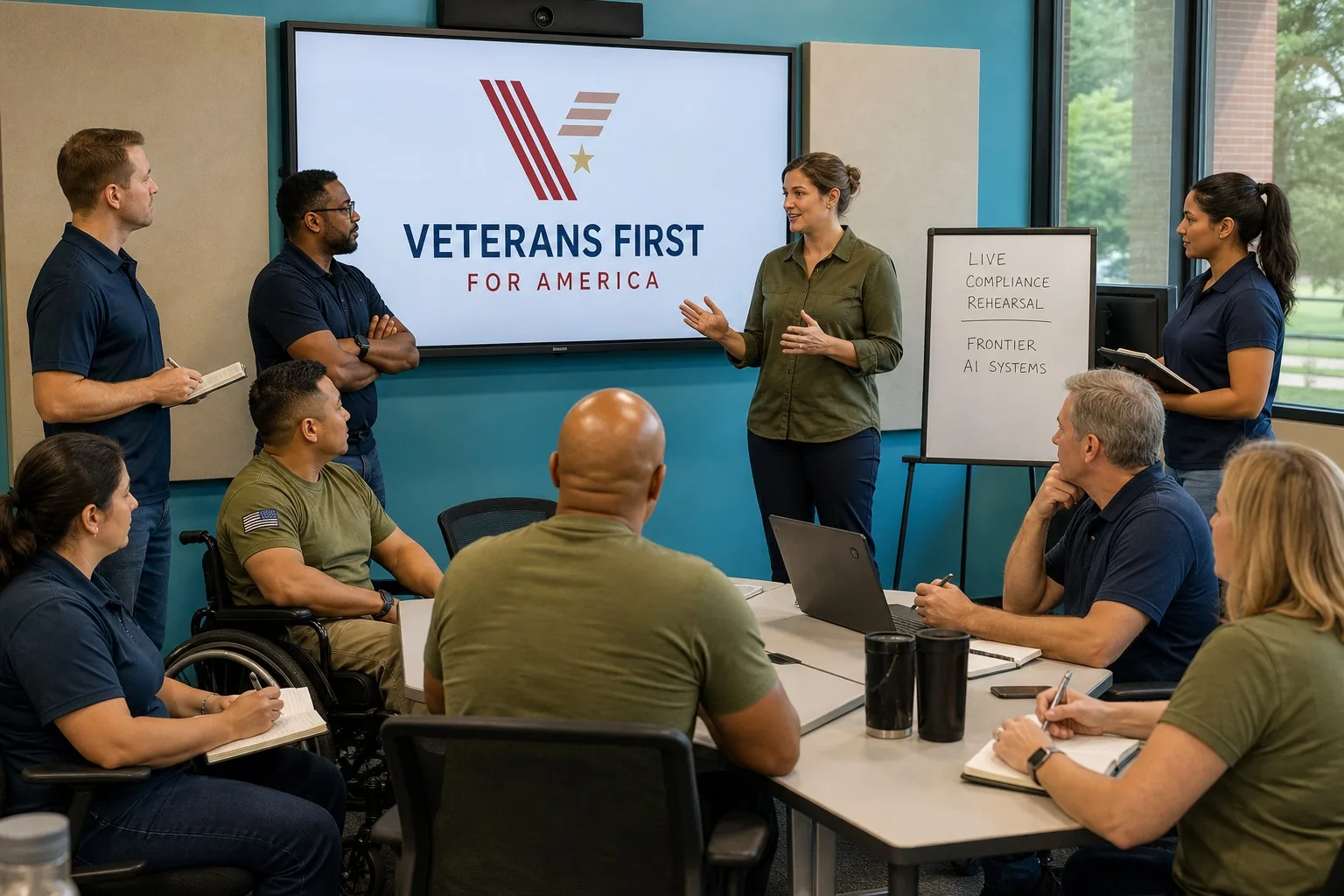
A veterans nonprofit says its AI-119 software helps companies using AI from OpenAI, Google, Meta and Anthropic prove they follow California’s new rules before the May 2027 deadline.
Key Takeaways
- Veterans First for America pitched AI-119 as a compliance product to help labs and enterprises meet California’s May 2027 frontier AI deadline
- AI-119 targets labs and enterprises working with frontier systems from firms including OpenAI, Google, Meta and Anthropic
- AI-119 is a policy and operations layer focused on documentation, testing, monitoring and governance rather than model weights
- Veterans First for America positions AI-119 to deliver verifiable logs, approvals and rehearsal records required by regulators before the AI Deadline
The organization said AI-119 targets labs and enterprises working with frontier systems from firms including OpenAI, Google, Meta and Anthropic. The release was issued by Veterans First for America, so the claims apply to that organization’s product rather than the named labs.
AI Deadline pressures are cited as the primary market driver.
AI Deadline, AI-119 Sells Compliance, Not Compute
AI-119 is not a foundation model. It is a policy and operations layer focused on documentation, testing, monitoring and governance rather than model weights.
The product is built around four operating pillars that “must be implemented and verified before the rule takes effect,” a formulation the organization uses to describe the California requirement, and vendors like Veterans First for America are positioning AI-119 as an operational response to that mandate.
This operational response matters because California’s framework turns abstract safety goals into concrete obligations and verification steps that companies must operationalize. The rule’s language, “must be implemented and verified before the rule takes effect”, creates a checklist that companies will need to translate into day-to-day controls, including who tests models, how results are recorded, who signs off on deployments and what incident response actions are triggered.
Enforcement changes incentives.
Announced intent will not satisfy regulators. They will seek evidence of implementation.
That elevates vendors that can deliver verifiable logs, approvals and rehearsal records by the May 2027 AI Deadline, and reframes compliance as an operational problem for named firms and their customers.
The compliance burden lands squarely on the companies named in the pitch and their customers. OpenAI, Google, Meta and Anthropic face operational questions.
Can they supply partners and customers with the logs and attestations required, or will customers rely on third-party stacks like AI-119 to bridge gaps? If regulators demand proof rather than promises, firms that fail to provide demonstrable, auditable processes risk enforcement actions once the AI Deadline arrives.
Also Read: Verifiable Rewards Drive Critical Move Beyond RLHF At Frontier Labs
California AI Rules Create A New Vendor Class
A frontier AI rule usually focuses on systems that can create broad public risk if misused or poorly controlled.
That can include model evaluation, incident response, access controls and audit logs. In practice, a company may need to show both technical safeguards and a paper trail.
That creates room for companies like Veterans First for America.
They are not competing on model quality. They aim to sit beside the model and manage governance.
As AI becomes regulated infrastructure, demand grows for that layer, the software that helps customers prove they are using platforms safely, as seen in cloud security and financial compliance.
From Safety Debate To Procurement Line Item
The policy debate around frontier AI shifted from abstract risks in 2024, 2025 to procurement-focused spending by late 2026. Legal, risk and security teams now buy tools to document controls, rehearse incidents and satisfy auditors before deadlines.
AI-119 packages workflows, templates and verification steps around models buyers already use.
For customers that cannot demonstrate controls internally, the purchase case is straightforward. They can pay for a product that can show auditors a record by the AI Deadline.
How AI-119 Could Fit Into AI Governance
AI-119 appears designed to sit between a model provider and the deploying organization.
A bank or hospital might use Anthropic or OpenAI models but still need its own rules for access, monitoring and escalation. The middle layer can collect logs, map business uses to policies and flag when systems cross thresholds requiring human review.
The key test will be enforcement.
If California’s framework imposes real verification pressure in 2027, tools like AI-119 will move from innovation budgets into security and compliance budgets as firms race to demonstrate verifiable processes before the AI Deadline.
Read Next: AI That Upgrades Itself Flops On Tough New Puzzle Test